
How to Transfer Credit Card Points to Airlines and Hotels: A Beginner’s Guide
For those who are new to this (and honestly, for some who have been at it for a while)… if you have a Chase, American Express, Citi, Capital One or Bilt credit card, those points sitting in your account balance? Yeah… those are extremely valuable, depending on how you use them.
You’ve probably heard of airline miles and hotel points (United, Delta and American miles, Marriott points and so on), which are tied to that one airline or hotel. Chase, Amex, Citi, Capital One and Bilt (along with a few other banks) give you something different called transferable points. They aren’t locked to one loyalty program, so you can move them over to the airlines and hotels each bank partners with and get way more out of them. In this guide I’m going to walk you through what that actually means, what to check before you move a single point, and exactly how to do the transfer… let’s get started.
What does transferring points actually mean?
Let’s get the lingo straight first, because these get mixed up all the time. Your credit card points live in your bank’s rewards program (Amex Membership Rewards, Chase Ultimate Rewards, Citi ThankYou, Capital One Miles, Bilt Points). Airline miles live in the airline’s own loyalty program (United MileagePlus, Air Canada Aeroplan, Air France-KLM Flying Blue and so on), and that’s where award flights get booked. You can spend your bank points like cash in the bank’s travel portal and let the bank book the flight for you… or you can transfer them into your own airline account, where they turn into miles, and book the award seat directly with the airline. That second option is what this guide is all about.
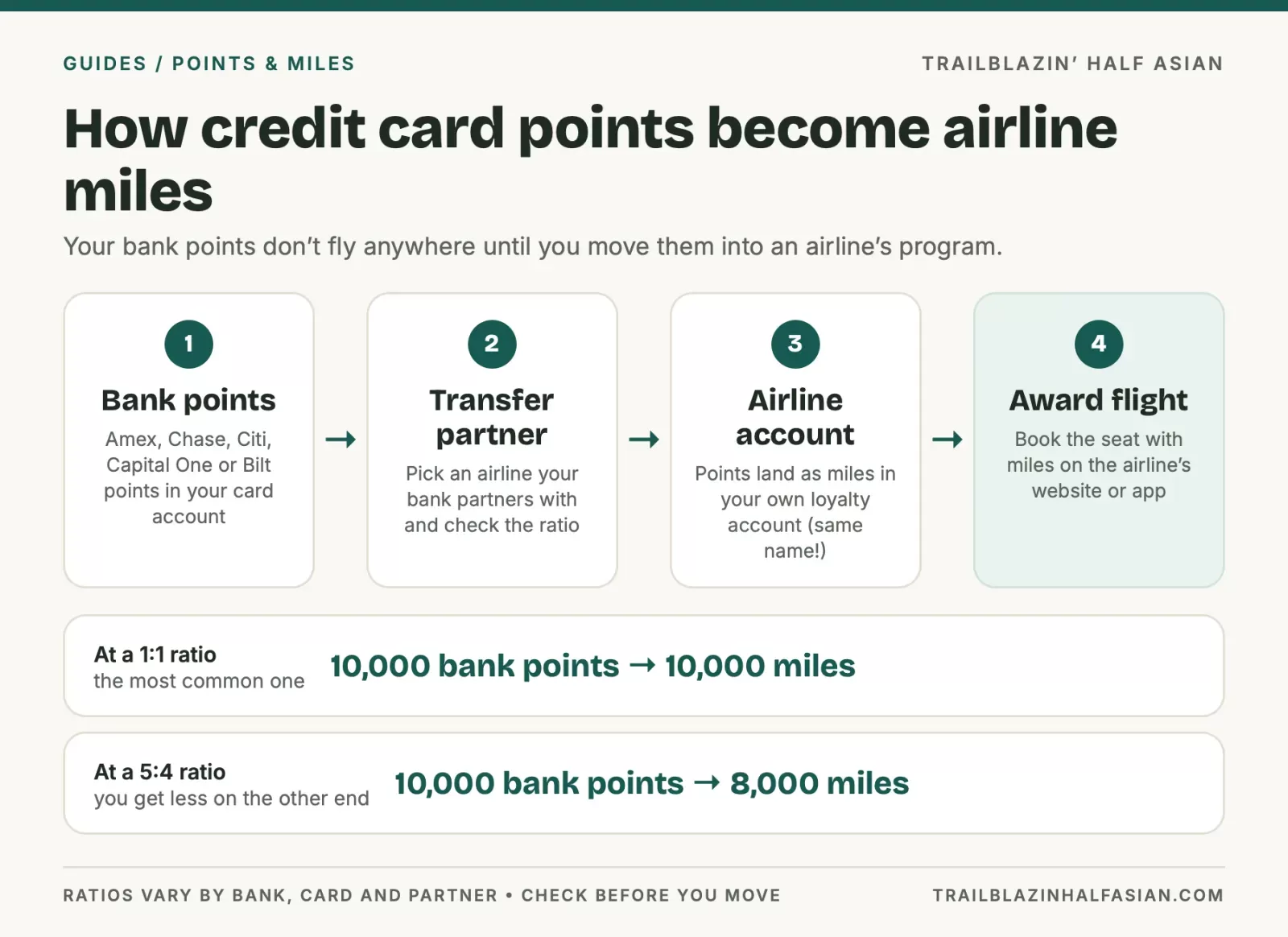
The transfer ratio tells you how many miles you get on the other end. The most common (and best) is 1:1, meaning 10,000 Chase points become 10,000 United miles. You’ll also see ratios like 5:4 (10,000 points become 8,000 miles, usually not a great deal) or 1:2 (10,000 points become 20,000, which sounds amazing, but only if those 20,000 are worth more than what you gave up). Ratios change by bank, by partner and sometimes by which card you have, so always check the number on the transfer screen before you hit go.
Why the bank travel portals usually give you less
See, credit card companies (and most hotel and airline brands too) view your points as a liability on their books… why’s that? Because every point is basically a promise: at some point in the future, you can show up and trade it for a flight, a hotel stay, merchandise or cash, and they have to deliver. They can’t predict exactly when everyone will cash in, so they have to set money aside to cover it.
So naturally, they want you to clear those points off their books in the way that costs them the least. That’s where the travel portals come in: Chase Travel, Amex Travel, Citi Travel, Capital One Travel and Bilt Travel. They’re built to make redeeming super easy… but with ease comes a cost, and that cost is usually the value of your points. Most of these portals give you around 1 cent per point (Bilt Travel is 1.25 cents, and Chase’s Points Boost can get the Sapphire cards 1.5 to 2 cents, but only on select bookings). And the credit card companies are purposely not great at advertising transfers… but transferring to the right partner can stretch your points a whole lot further.
Let’s see an example. I’ll use the same hypothetical flight from my Should I Book With Points or Cash? guide: United flight UA881 from Chicago to Tokyo in Polaris Business, $5,091 one way, or 100,000 United miles + $5.60 in taxes and fees.
- Through Chase Travel at 1 cent per point: $5,091 = 509,100 Chase points. Even if Points Boost applied to this exact flight at 2 cents, it would still be 254,550 points.
- Transferring Chase points to United at 1:1: 100,000 Chase points become 100,000 United miles, and you pay the $5.60 in cash.
Same seat… over 400,000 points apart at the base portal rate. That’s why learning to transfer is worth it. Now, not every redemption looks this lopsided (and these aren’t live prices). Sometimes a cheap economy fare is a better deal through the portal, which is why you always do the math first.
Five things to check before transferring
Before transferring a single point, first thing is first… create a loyalty account with that specific program. You can’t transfer to an account that doesn’t exist, and some airlines won’t even show you award prices until you’re signed in. So sign up! I would also open it at least a day before you plan to transfer (more on why below). With that done, these are the things I check every single time:
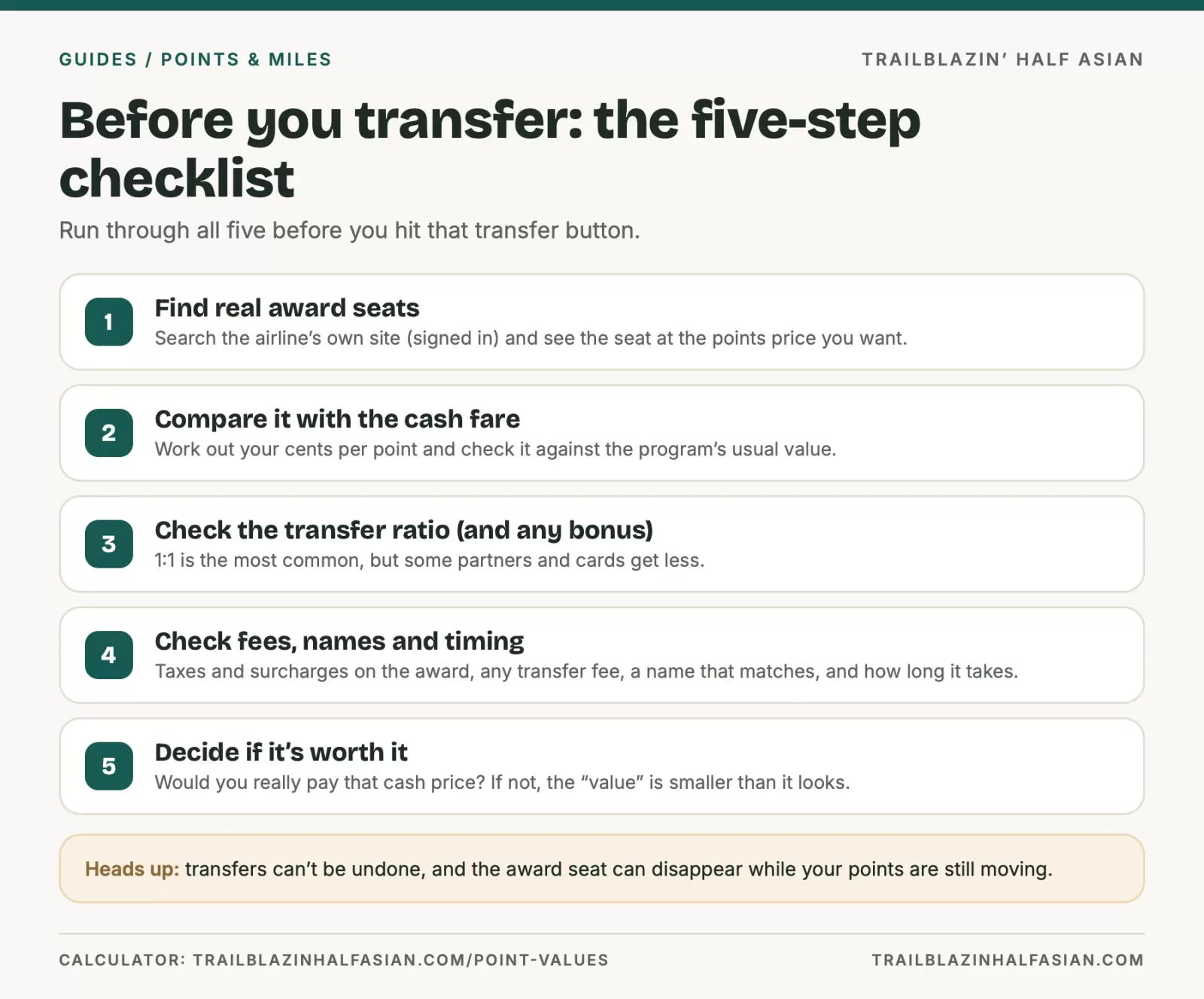
1. Confirm there are real award seats
I use seats.aero to find award flights, and rooms.aero and MaxMyPoint for hotel award nights. Once I find a date with a deal, I go to the airline’s own website, sign in, and make sure I can see that seat at that price before I move anything.
2. Compare the cash fare against the award cost
Next, I look up how much I would pay in cash for that same flight and do the math. My Should I Book With Points or Cash? guide walks through the formula, and the calculator at the bottom of the Trailblazin’ Half Asian Points Toolkit will do it for you: plug in the cash price, the points price and any taxes on the award, and it tells you your cents per point and whether that’s a good deal for that program.
3. Verify which banks transfer there, the ratio and any bonus
Not every bank partners with every airline, so you need to know which of your points can get there. Take a look at the chart below for some of the most popular partners (my full, searchable list for every airline is on the Where to Book page):
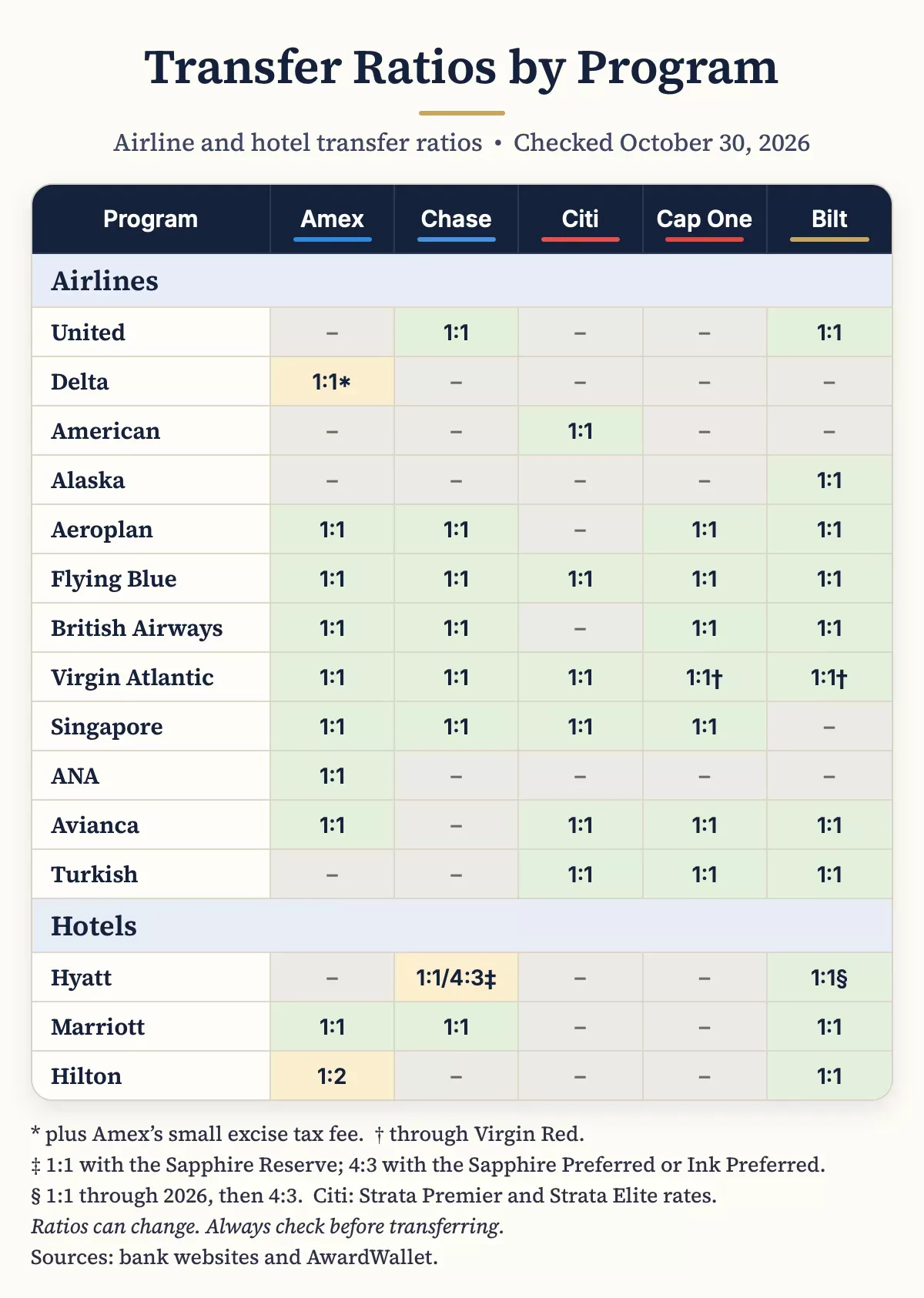
Bilt to Hyatt drops to 4:3 on January 1, 2027. Citi ratios are for the Strata Premier and Strata Elite; Citi’s other cards get fewer partners and often a lower rate.
Every now and then the banks run transfer bonuses (say, 25% extra miles to one airline for a few weeks). They’re great when you already have a trip in mind… but don’t transfer just because there’s a bonus, because the miles are stuck there once they move.
4. Check taxes, fees, timing and your account details
Some transfers come with a small fee. For example, Amex charges an excise tax offset of $0.0006 per point (60 cents per 1,000 points, capped at $99) when you transfer to U.S. airlines like Delta and JetBlue, so 50,000 points to Delta costs you $30. It’s really not much, but just something to keep in mind. Transfers are also usually done in 1,000-point increments with a 1,000-point minimum.
The award itself can come with taxes and fees too, and some programs add hefty “carrier surcharges” on certain airlines, so look at the full cash amount due before you commit.
Big thing to keep in mind as well… since this is a transfer from one points system to another, there may be a delay. Some transfers are instant, some take hours, some take days. I put together a chart of typical transfer times for every partner of all five banks further down (see “How long do transfers take?”), so check it before you move anything.
Lastly, when you link your loyalty account, double check that the member number is right and that the name matches the name on your card account (I usually verify three times… overkill, but I just want to make sure). A typo or a name mismatch is the fastest way to a stuck or failed transfer. And no, you generally can’t transfer into someone else’s account (Amex does allow an authorized user’s, and Citi ended its point sharing in May 2026)… but most airlines let you book an award ticket for someone else with your own miles.
5. Confirm that the transfer is worth making
This is the big one. Transfers can’t be undone. Once your points become miles, they’re stuck in that airline program. And award seats can disappear while your points are still on the way, especially on slow transfers. So only transfer when the seat is there, the math works, and you’re actually ready to book.
How to transfer Amex Membership Rewards points
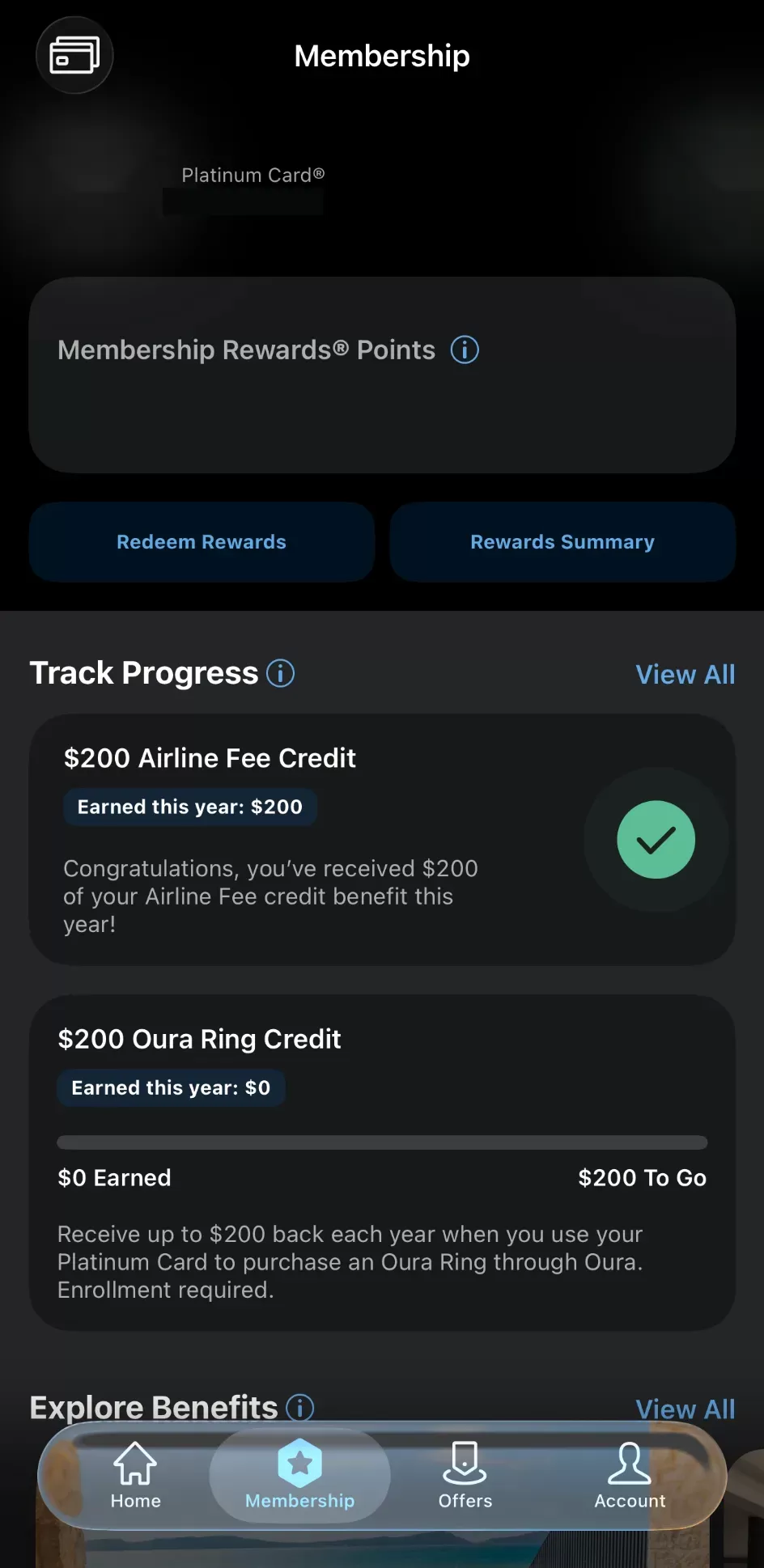
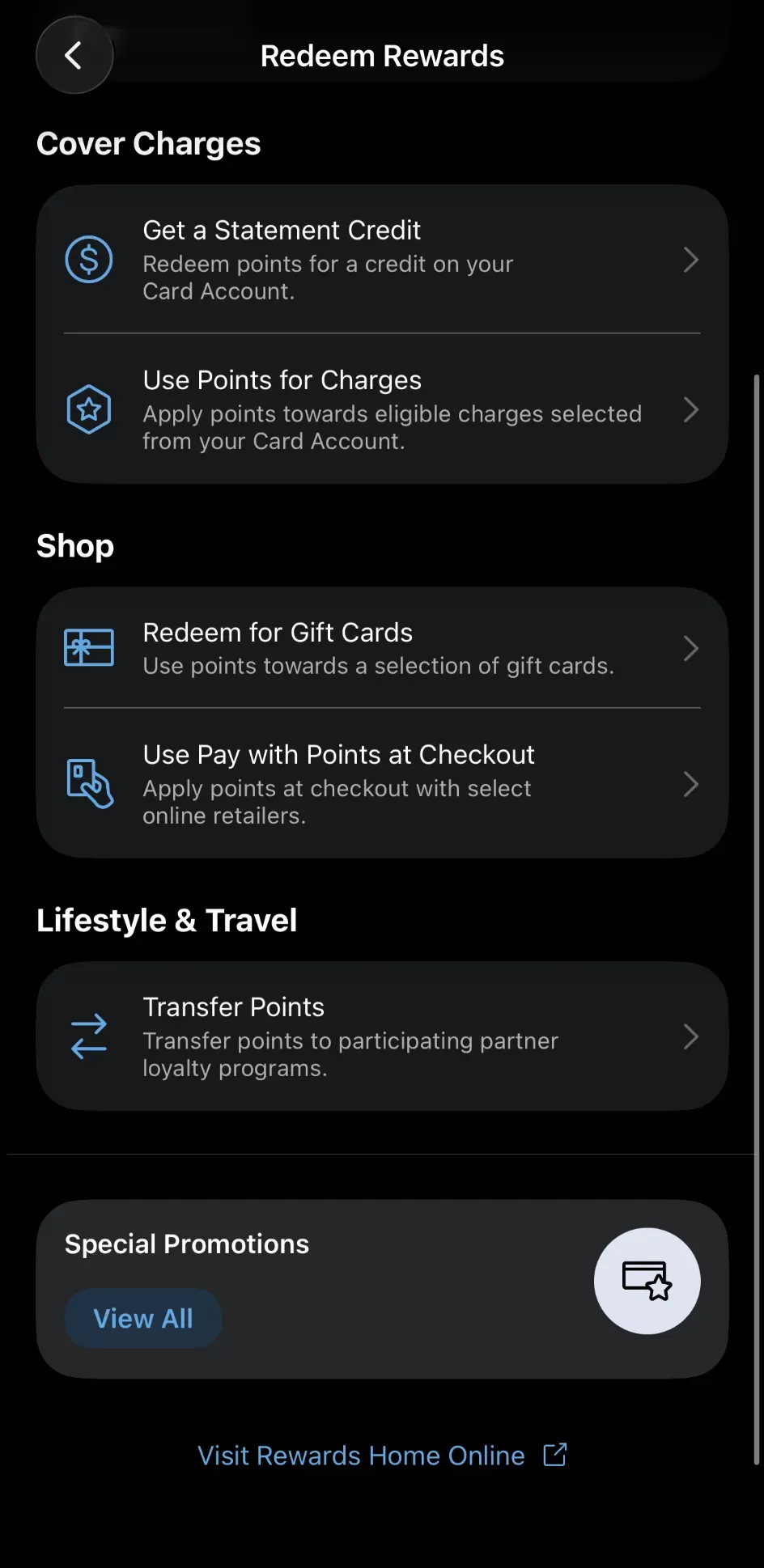
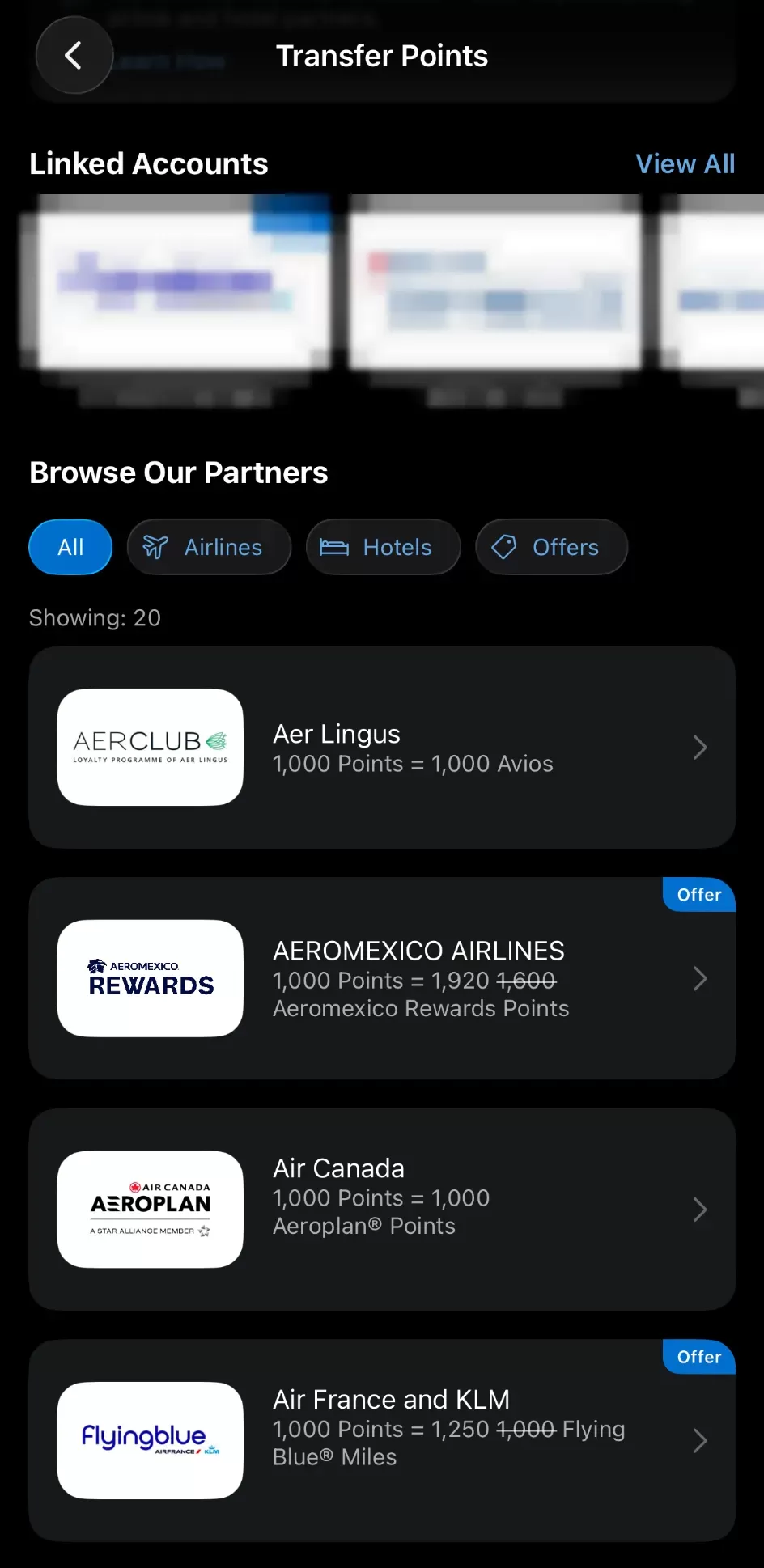
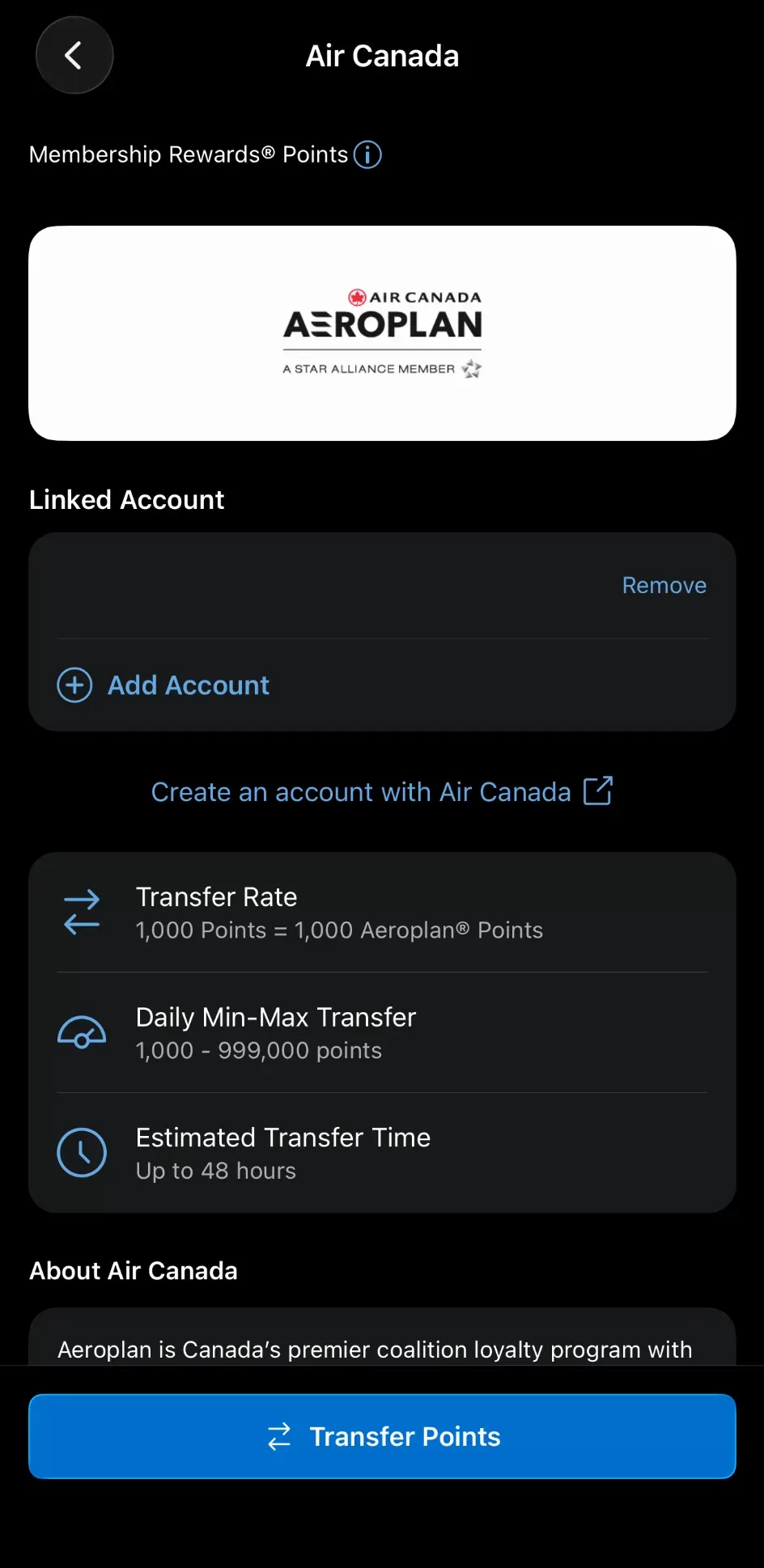
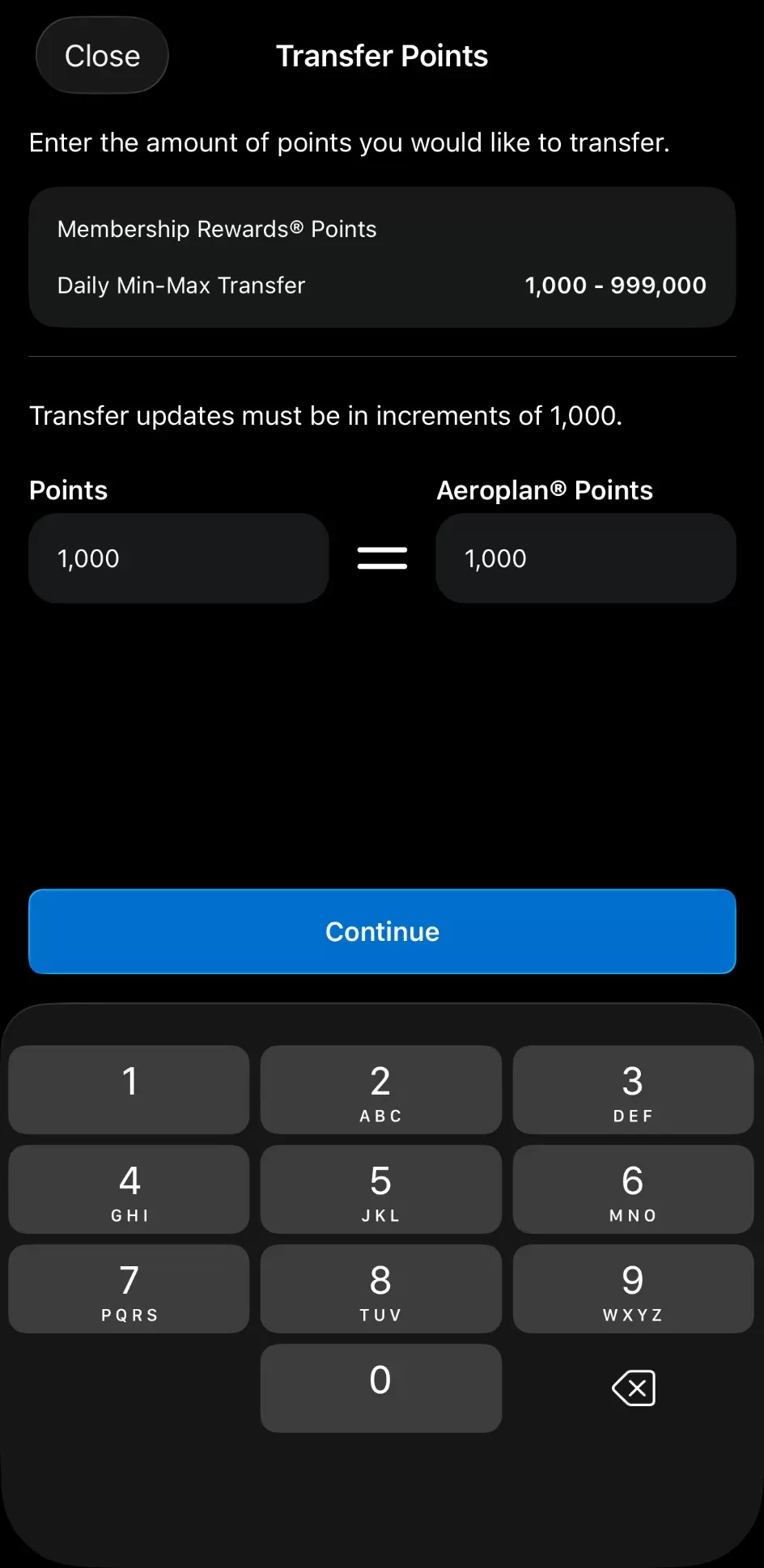
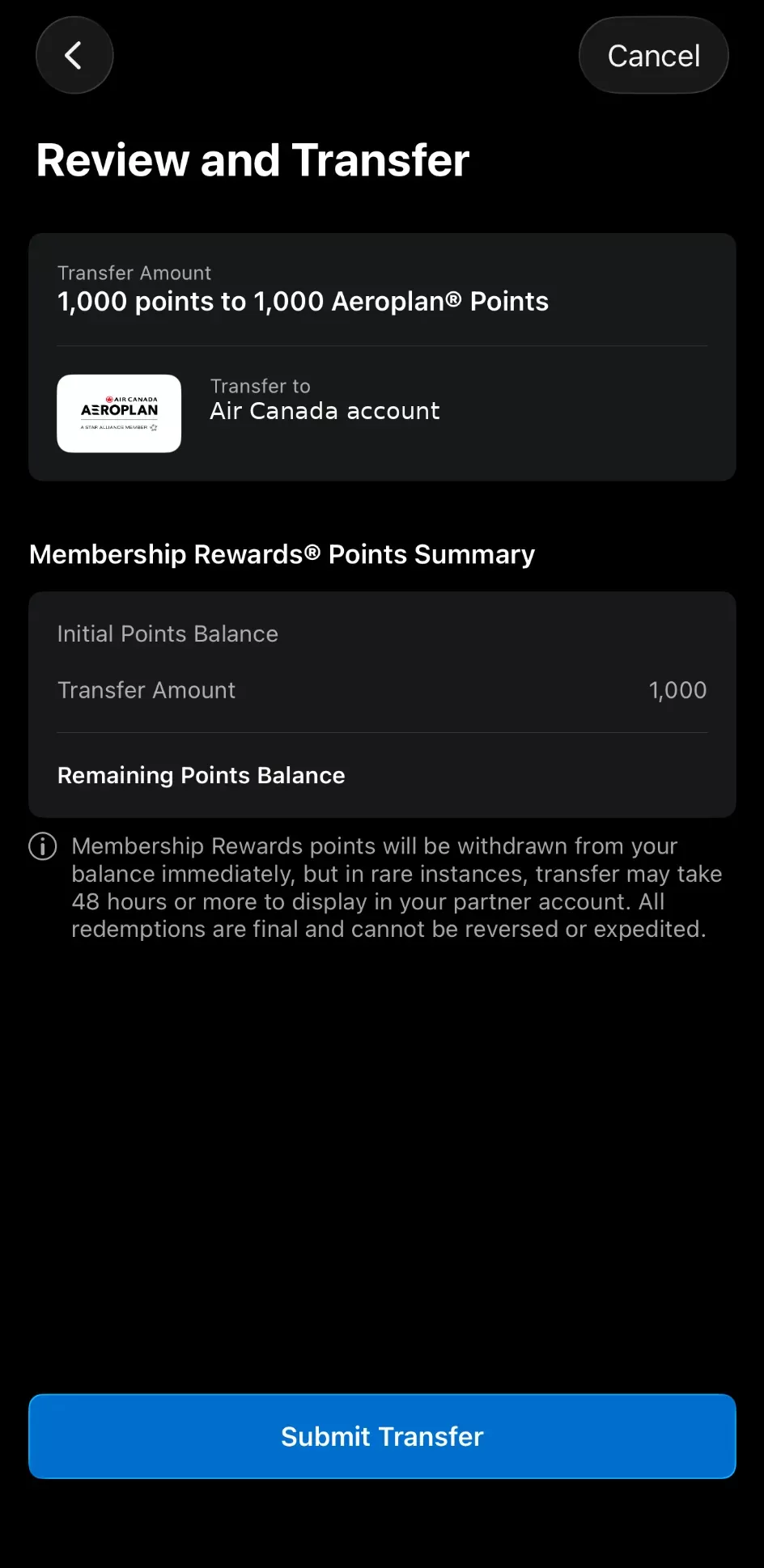
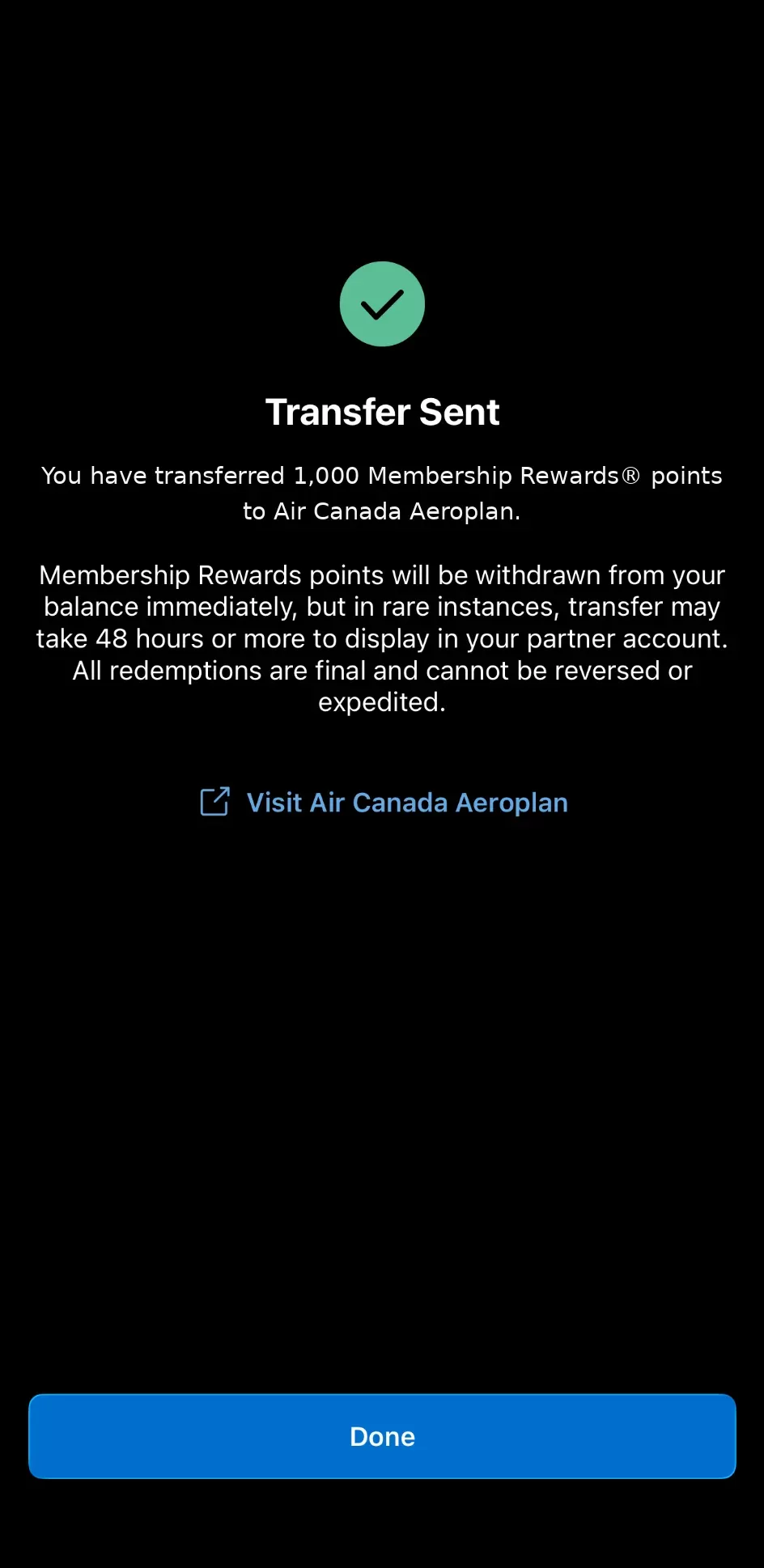
I use my Amex cards a lot, and Membership Rewards has a huge list of airline partners. I did all of this in the Amex app (the website works the same way), sending 1,000 points to Air Canada Aeroplan:
- Open the Membership tab and tap Redeem Rewards.
- Under Lifestyle & Travel, tap Transfer Points.
- Pick your airline or hotel. Any transfer bonuses running show up with an “Offer” tag.
- The first time, tap Add Account and enter your member number. The account has to be in your name (or an authorized user’s name on your card). This screen also shows the transfer rate, the daily limits (1,000 to 999,000 points) and the estimated transfer time. Then tap Transfer Points.
- Enter your points in 1,000-point increments and tap Continue. If it’s Delta or JetBlue, you’ll pay the small excise tax offset fee here too.
- Review everything and tap Submit Transfer. Amex says it’s final and can’t be reversed or sped up.
- Done! Amex takes the points right away and says the miles can take up to 48 hours to show up in rare cases (mine to Aeroplan are usually instant). Log in to the airline to make sure they landed before you book.
How to transfer Chase Ultimate Rewards points
Quick heads up first… not every Chase card can transfer to airlines and hotels. Only the Sapphire Preferred, Sapphire Reserve, Sapphire Reserve for Business and Ink Business Preferred can. The no-annual-fee cards (Freedom Unlimited, Freedom Flex, Ink Business Cash and Ink Business Unlimited) are sold as cash back cards, and on their own, that’s basically all their points are good for… cash back. To turn them into transferable points, you need one of those transfer cards too. Then you use Chase’s free Combine points option to move the points over to it, and transfer from there.
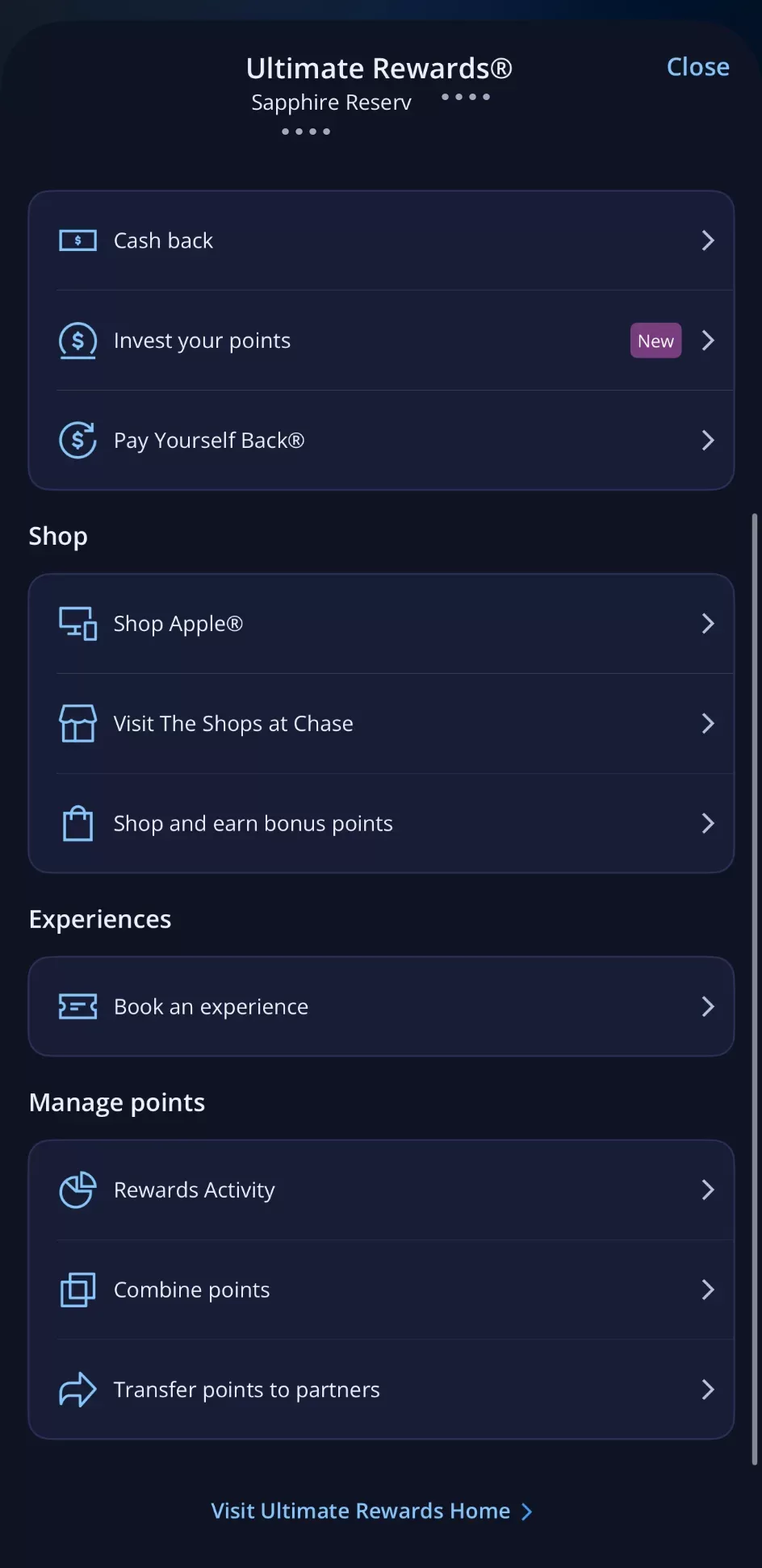
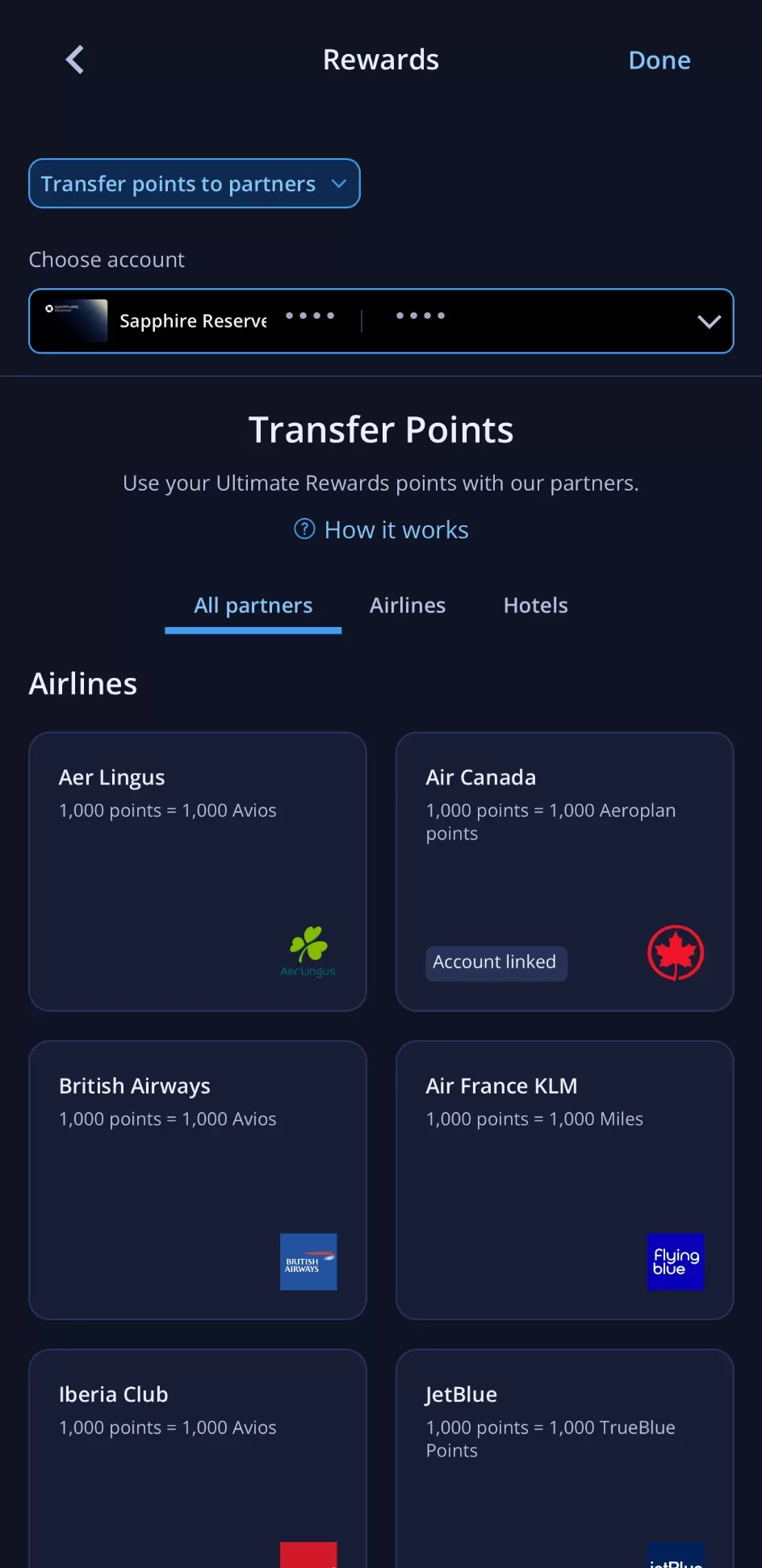
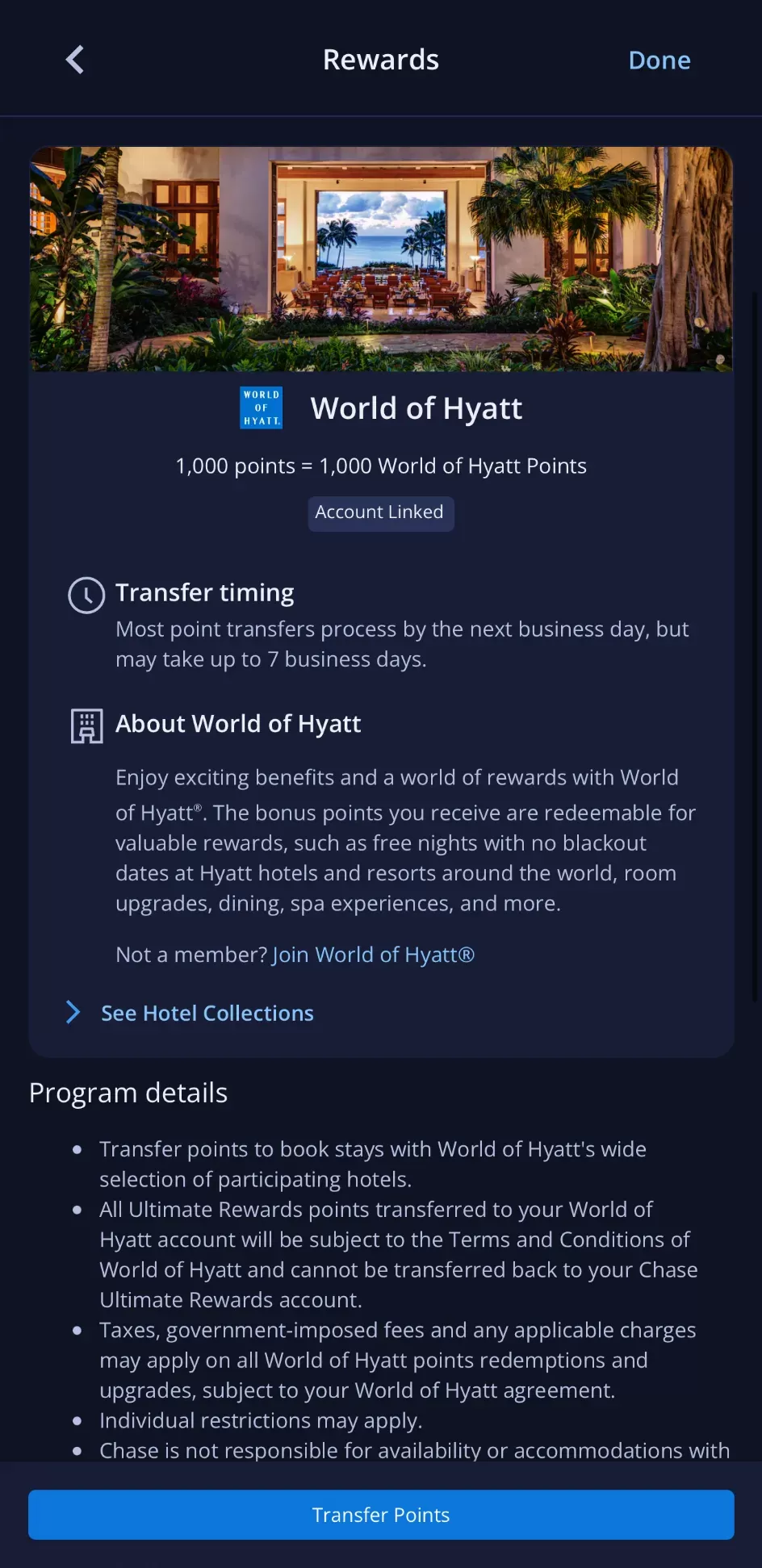
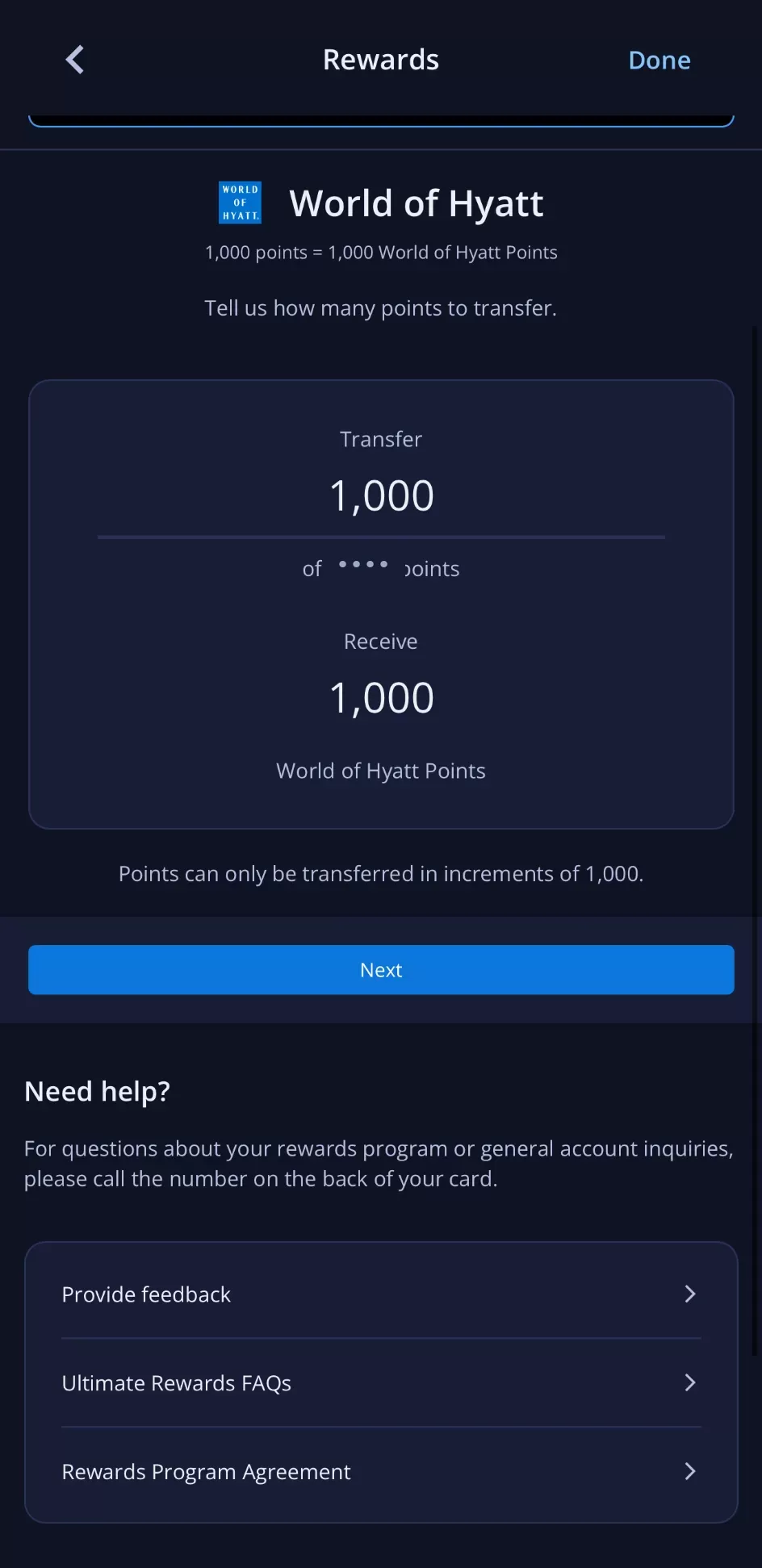
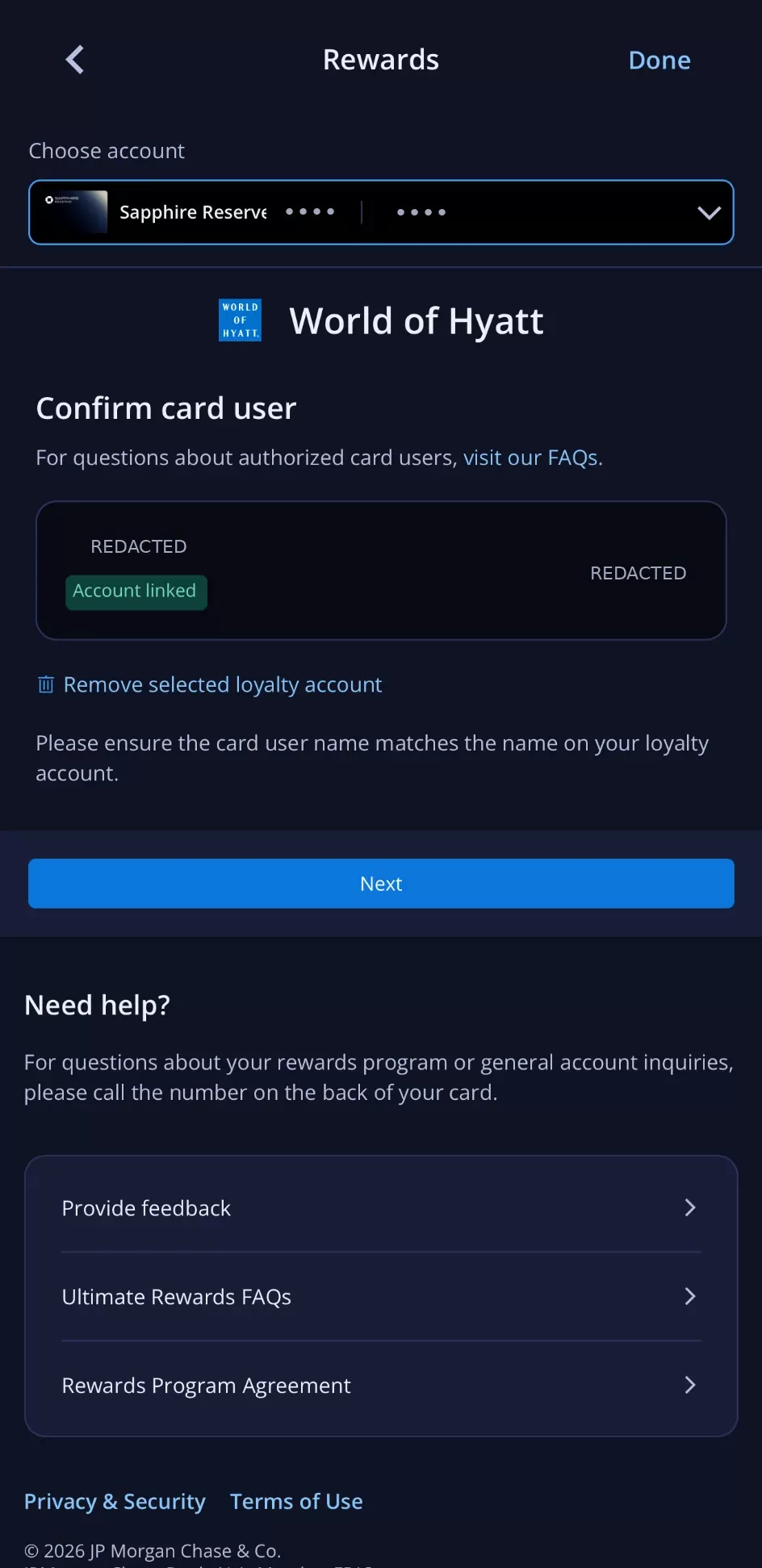
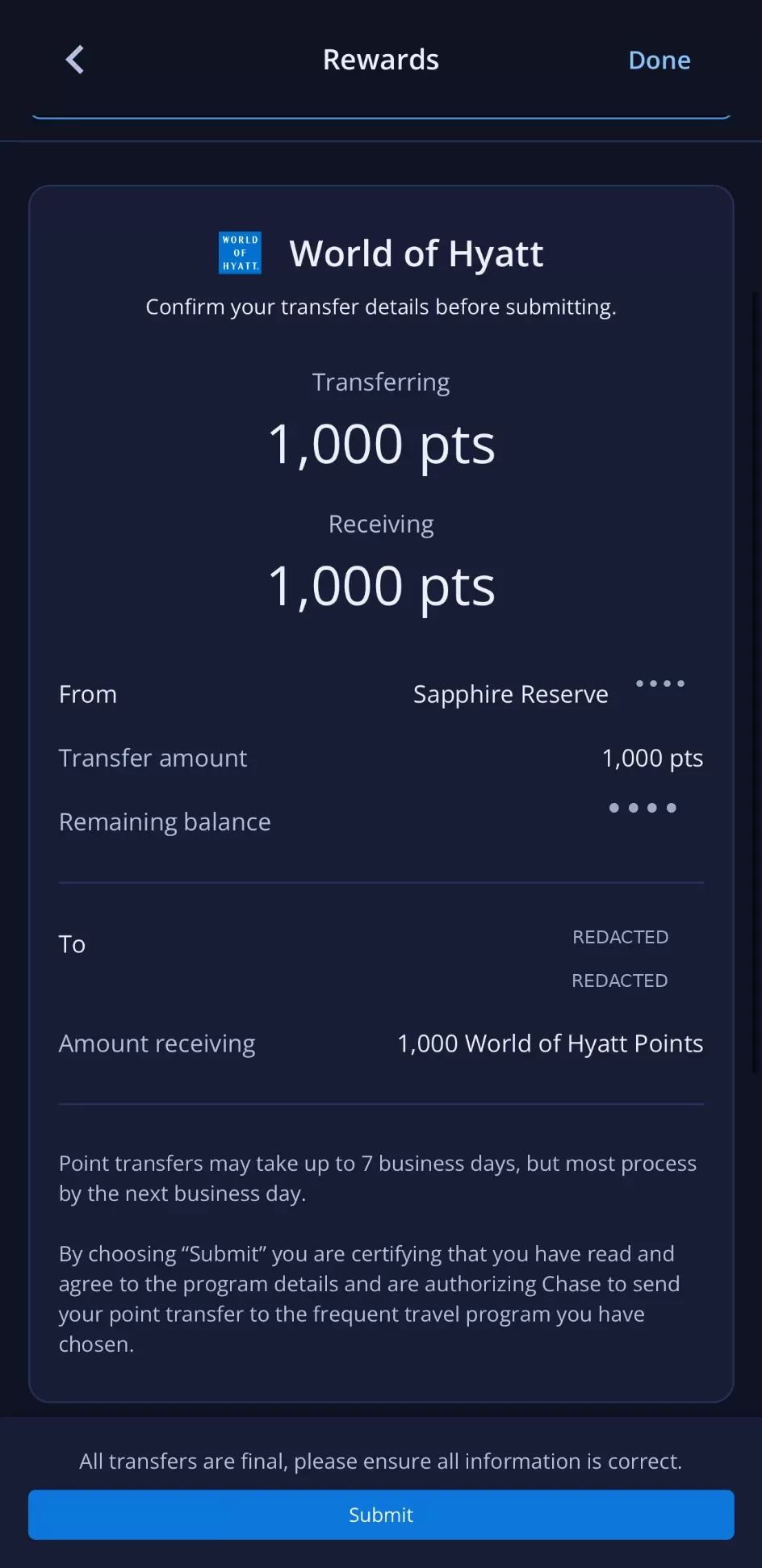
This is how I sent 1,000 points from my Sapphire Reserve to World of Hyatt in the Chase app:
- Open Ultimate Rewards and, under Manage points, tap Transfer points to partners (use Combine points first if your points are sitting on a Freedom or Ink Cash/Unlimited card).
- Choose the card that holds your points, then pick the airline or hotel.
- Check the ratio and the transfer timing on the partner page (and link your loyalty account the first time), then tap Transfer Points.
- Enter your points in 1,000-point increments and tap Next.
- Confirm the card user and the linked loyalty account. Chase reminds you the names have to match.
- Review and tap Submit. All transfers are final.
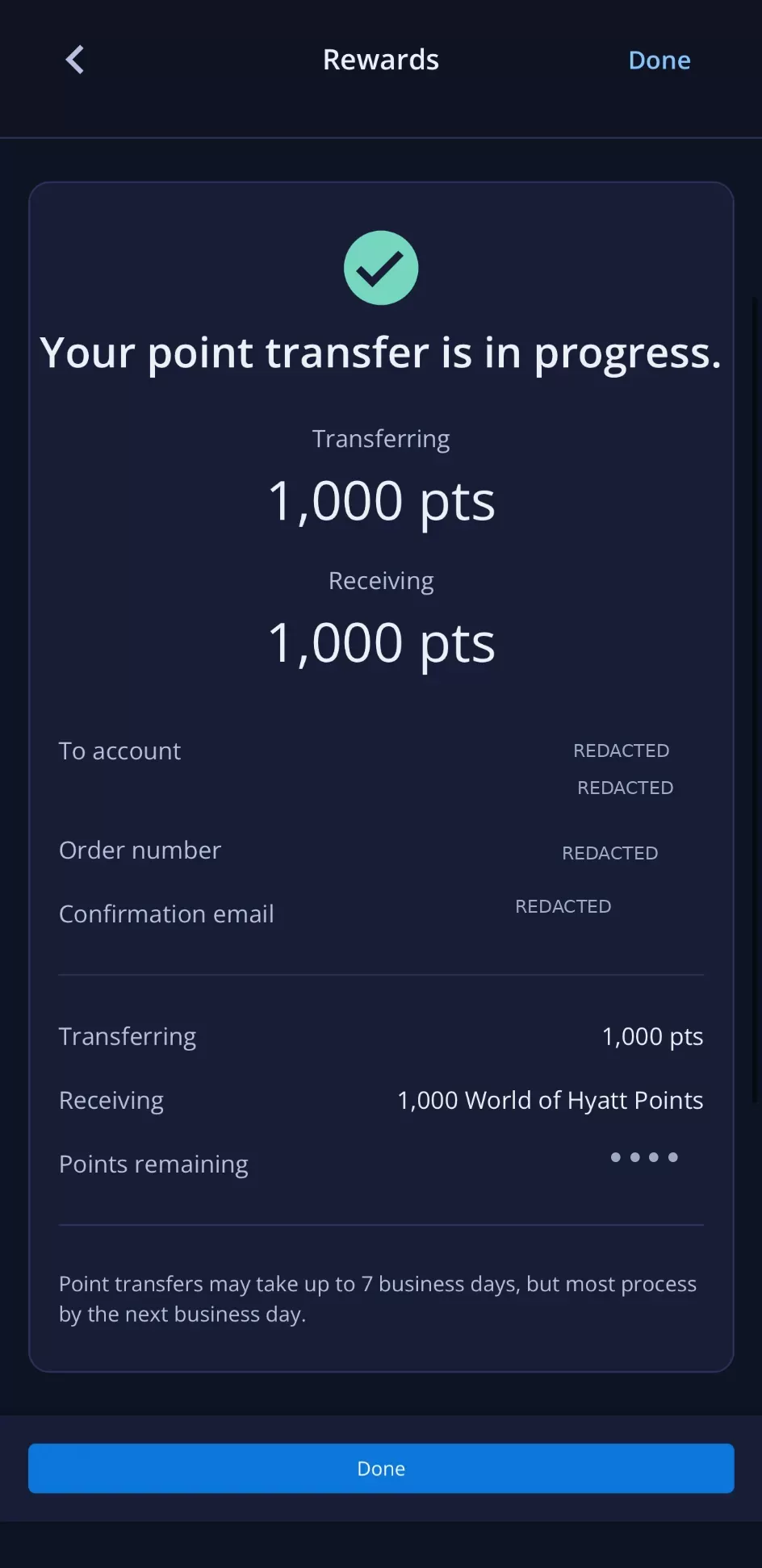
- Your transfer is in progress! Chase says most post by the next business day but can take up to 7 business days (AwardWallet’s data shows Hyatt and United are usually instant).
How to transfer Bilt points
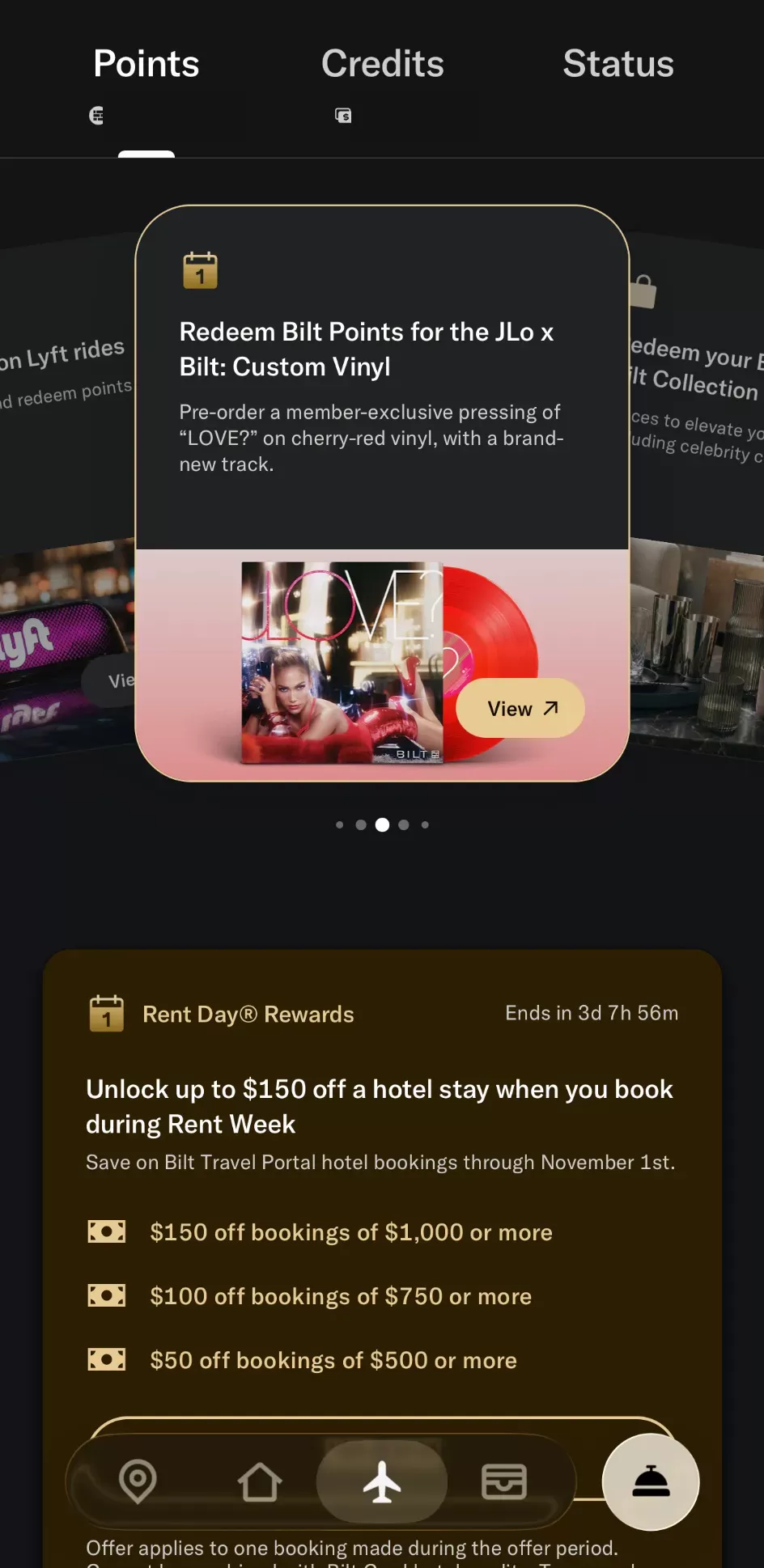
Bilt is the one most people forget about, and it has some of the best partners out there (it’s the only one besides Chase that transfers to United and Hyatt, and the only one that goes to Alaska). Everything happens in the Bilt app, and I sent 1,000 points to World of Hyatt:
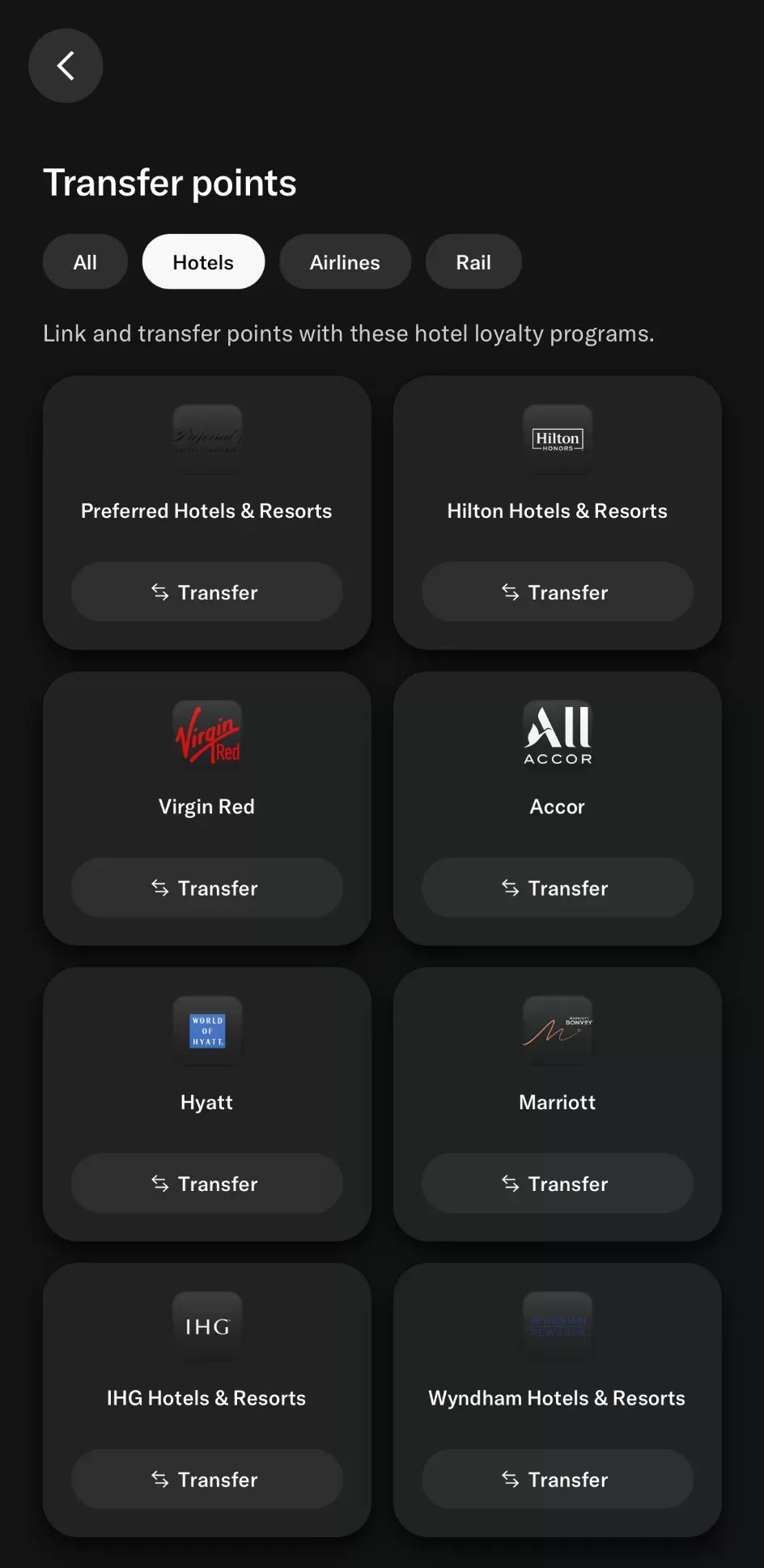
- Open the app and go to the Points tab.
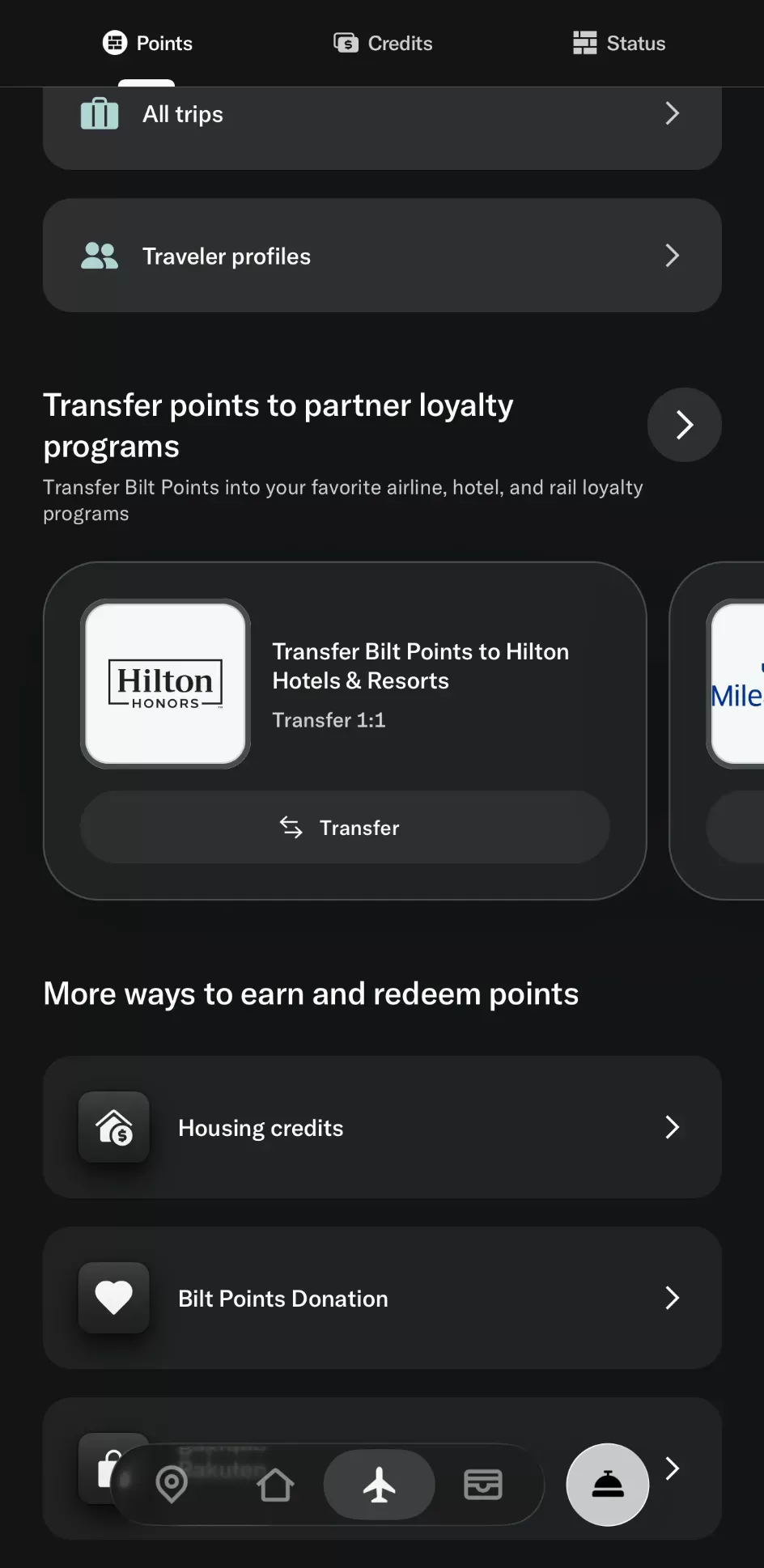
- Scroll down to Transfer points to partner loyalty programs and tap the arrow.
- Filter by Airlines, Hotels or Rail and tap Transfer on your program.
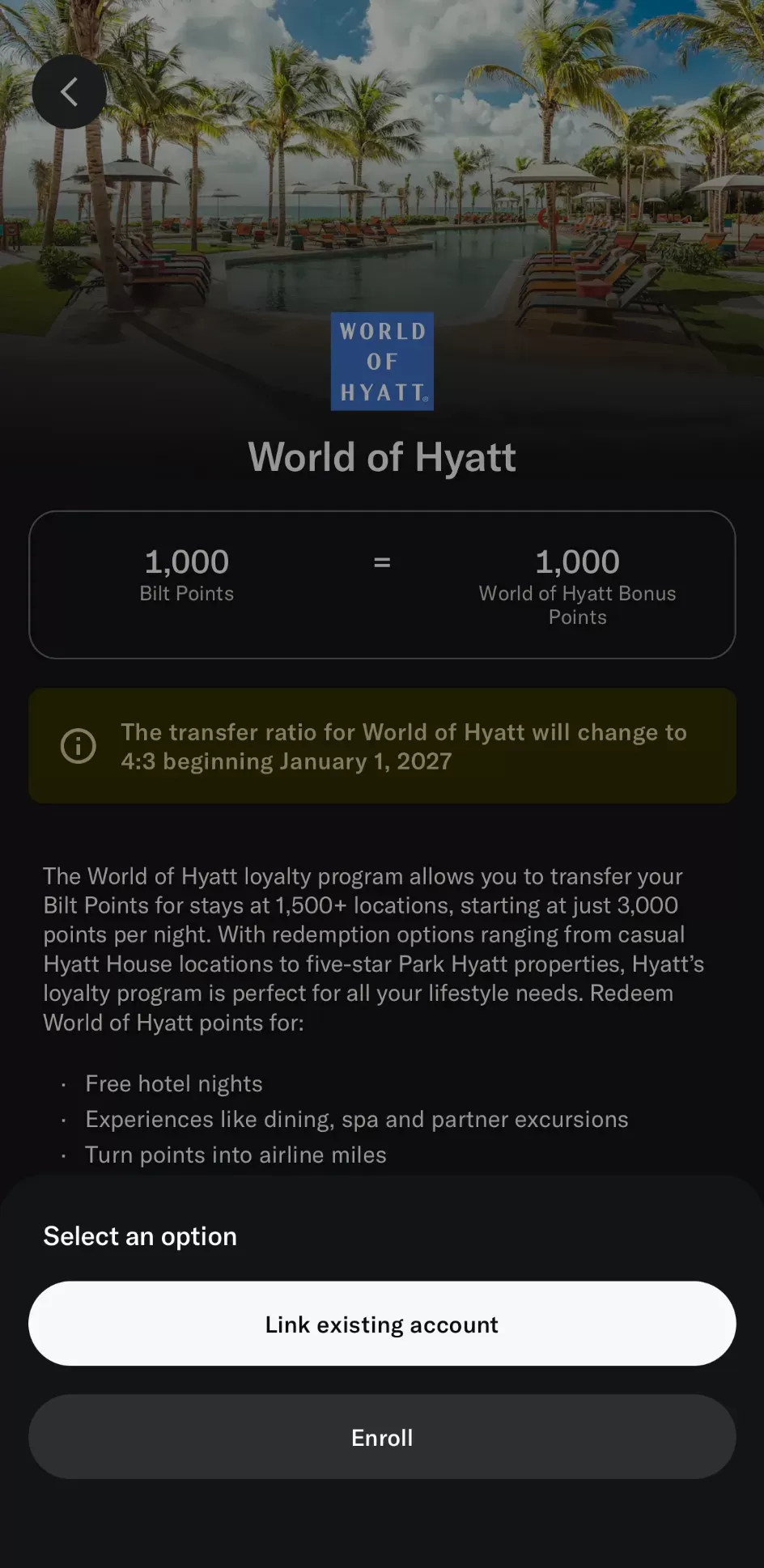
- Check the ratio (heads up: Bilt to Hyatt changes to 4:3 on January 1, 2027) and tap Enroll or link accounts.
- Tap Link existing account and enter your member number (or Enroll if you don’t have one yet).
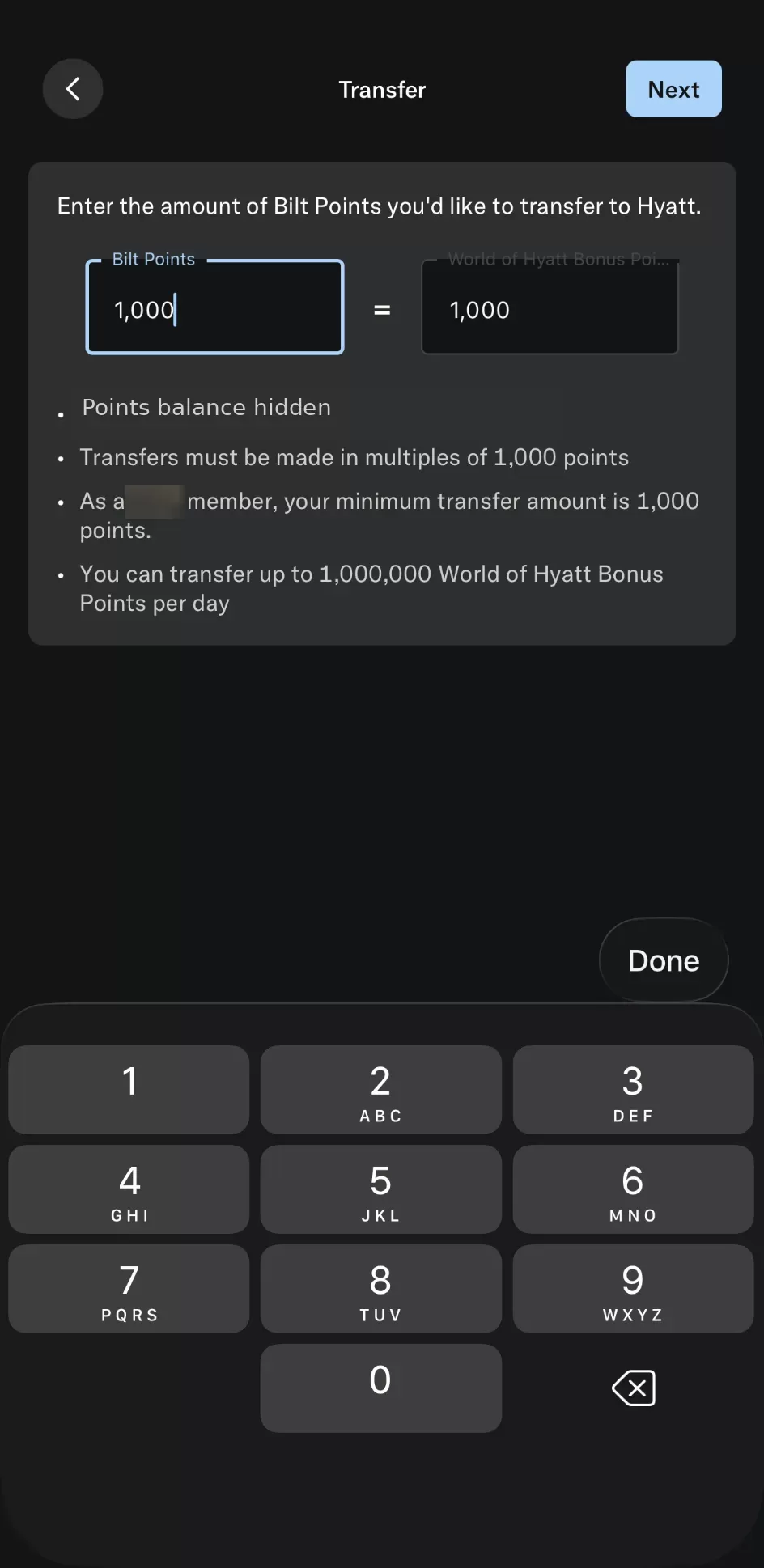
- Enter your points in multiples of 1,000 and tap Next. The minimum depends on your Bilt status, and the app shows yours on this screen.
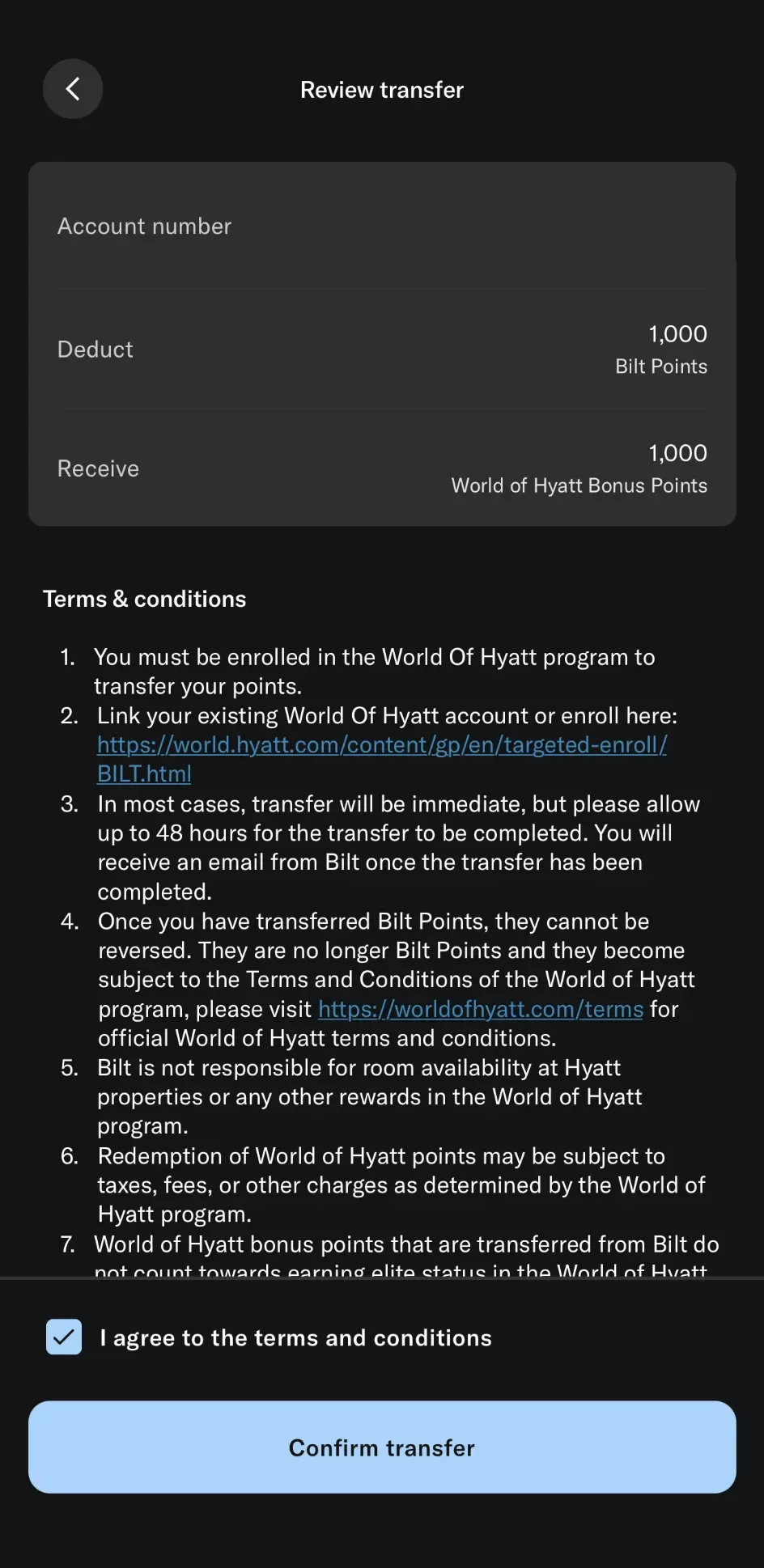
- Review it, read the terms, tick the box and tap Confirm transfer. Bilt transfers can’t be reversed either.
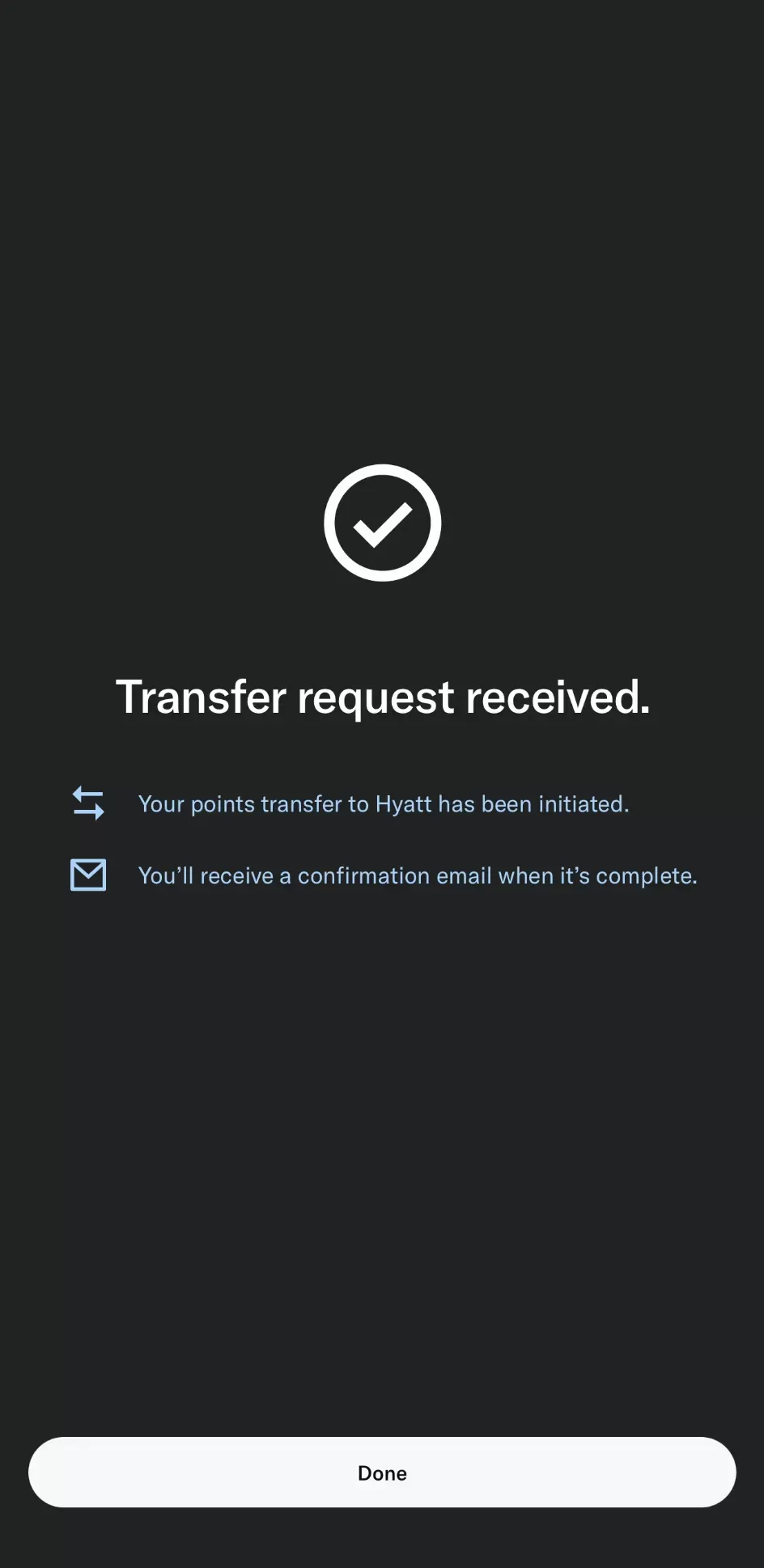
- Transfer request received! For Hyatt, Bilt says it’s usually immediate but to allow up to 48 hours, and it emails you when it’s done.

How to transfer Capital One miles
Unfortunately, I’ve never had a Capital One card, so everything here comes from Capital One’s own guide to transfer partners, and my own research, not my account.
You need a Capital One travel rewards card (Venture X, Venture or VentureOne) or a business travel card (Venture X Business, Venture Business or VentureOne Business). Cash back cards like Quicksilver aren’t on that list. To transfer, sign in online or in the Capital One Mobile app, go to the rewards section, choose to transfer your miles, pick a partner and confirm. You need at least 1,000 miles, and the name on your Capital One account has to match the name on the loyalty account.
Check the ratio every time: Capital One says most of its airline partners are 1:1, but Emirates, EVA Air and Japan Airlines are 2:1.5 (1,000 miles become 750) and JetBlue is 5:3 (1,000 become 600). And just like everyone else, Capital One says transfers can’t be moved back once they’re finalized.
How to transfer Citi ThankYou points
I had the Citi Strata Premier until I closed it in October 2026, so I don’t have the screens anymore… this part is based on Citi’s card pages and the ThankYou site.
Card eligibility matters a lot with Citi. The Strata Premier and Strata Elite (and the old Prestige) get Citi’s full partner list at the full rate, which is 1:1 for most airlines. The base Strata card and the no-annual-fee cards (like the Double Cash) can only transfer to a shorter list of partners, often at a lower rate, for example 1,000 points becoming 700 miles.
To transfer, sign in at thankyou.com (or through the Citi app’s rewards section), go to the points transfer option, pick the airline, enter your member number and the number of points, and confirm. The minimum is 1,000 points, and you can move up to 500,000 in one go. Citi says a transfer can take up to 14 days to process, so give yourself some cushion.
Four banks, one airline program
One cool thing to point out… the airline program can matter more than the credit card brand. Air France-KLM Flying Blue is a great example, since it’s a 1:1 transfer partner of Amex, Chase, Citi and Capital One (and Bilt too).
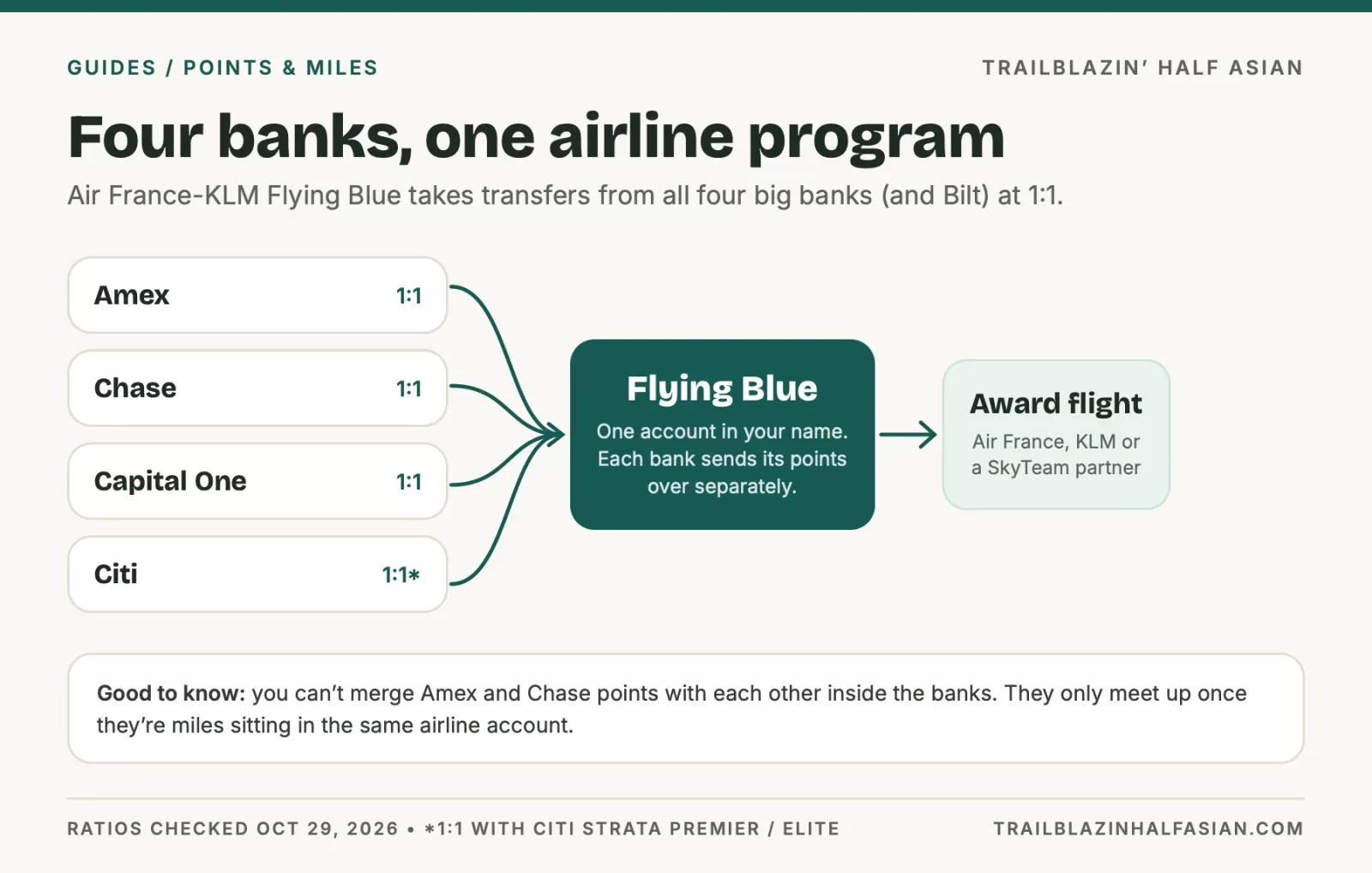
So if you have a few thousand points in one bank and a few thousand in another, you can send both into the same Flying Blue account (in your name) and book one award with the combined miles. Just know that the banks don’t talk to each other. You can’t move Amex points into Chase or anything like that. Each bank transfers its points separately, under its own rules, and they only come together once they’re miles in the airline account.
When should you NOT transfer points?
Now, there are times when you should NOT transfer your points:
- There’s no award seat you can book. No seat, no transfer. Period.
- The cents per point comes out low. Keep the points and pay cash, or find a better redemption.
- The taxes and surcharges are huge. An award that still costs hundreds of dollars in fees isn’t much of a deal.
- The cash fare is cheaper. Sometimes a sale fare just beats any award.
- Your plans aren’t set yet. Bank points can go anywhere, but airline miles are stuck with that airline and its partners.
- The cancellation rules are strict. Some programs charge fees or limit refunds on awards, so read those first.
- You’re only doing it for a transfer bonus. A 25% bonus is only worth it if you’ll use the miles.
Timing matters too. I would highly recommend NOT transferring to a program with a multi-day transfer time for rare awards, like first class seats. Those can be gone within minutes to hours of showing up. ANA Mileage Club is a perfect example: from Amex it can take a couple of days.
And remember how I said to open your loyalty account a day early? Let me tell you why. I was helping my friend transfer Amex points to Air Canada Aeroplan to book a flight, and he had opened his Aeroplan account just an hour before the transfer. Aeroplan transfers are usually instant… this one took two days, which was unheard of for me. Months later we transferred again to that same account and it was instant. Brand new accounts sometimes just need time to register in the airline’s system, so giving it 24 hours can save you a headache.
And please… never redeem your points for merchandise or gift cards, like an iPad. Those redemptions usually give you a fraction of a cent per point, and the card companies love it because they clear a big chunk of liability off their books for something that doesn’t cost them all that much.
How long do transfers take? The big chart
These two charts have every airline and hotel partner of all five banks, and how long a transfer typically takes to show up. Most of these are the average times AwardWallet measures from real transfers (updated October 29, 2026). Where AwardWallet didn’t have enough data, I filled in from Frequent Miler, One Mile at a Time, DealsPoints and Roame. Shoutout to them for tracking all of this! When the sources didn’t agree, I show the range, so plan for the slow end. Fair warning… this isn’t an official table, and the banks don’t promise any of these times (Citi even says a transfer can take up to 14 days). On a phone, pinch to zoom in on the charts.
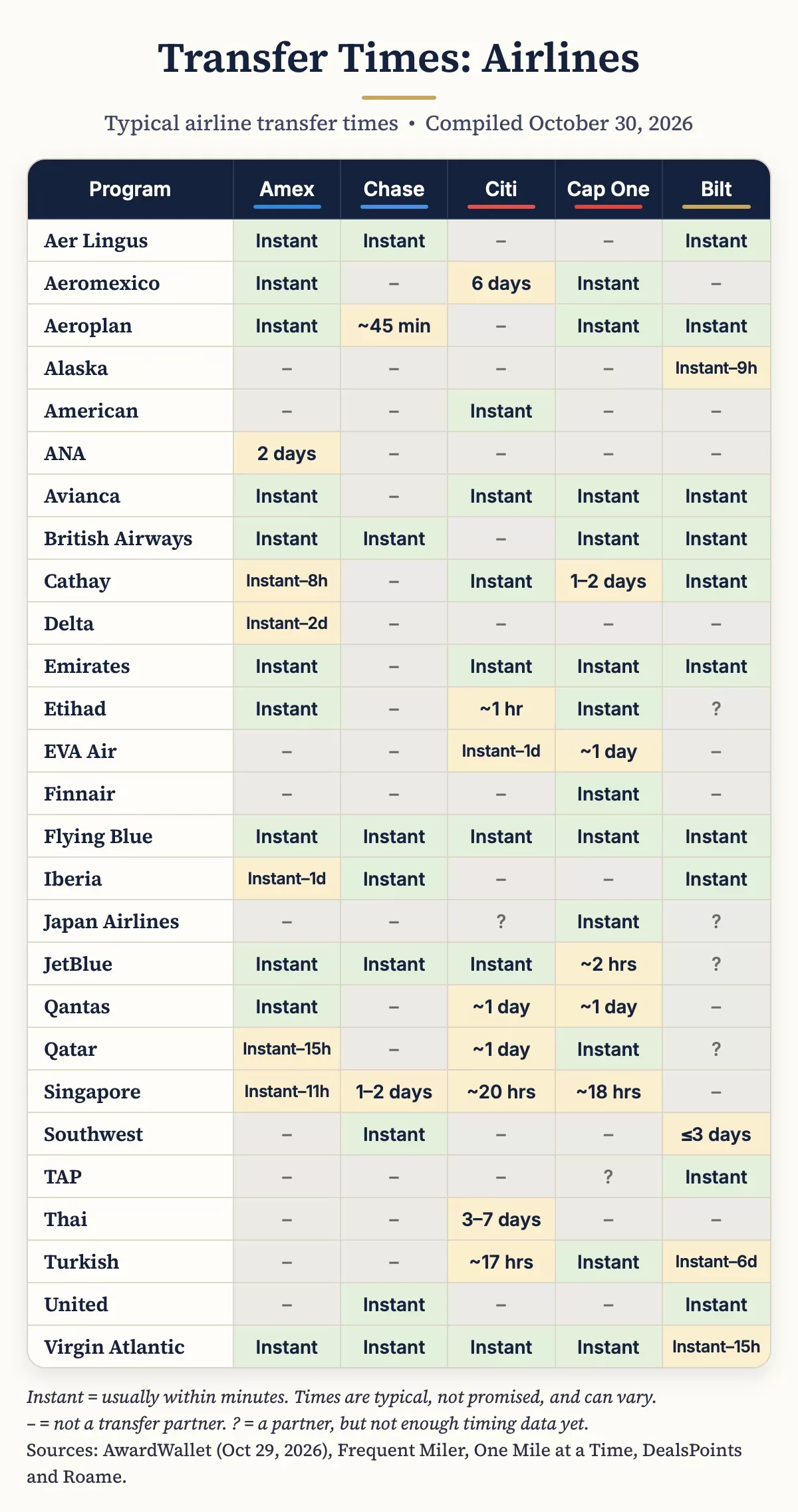
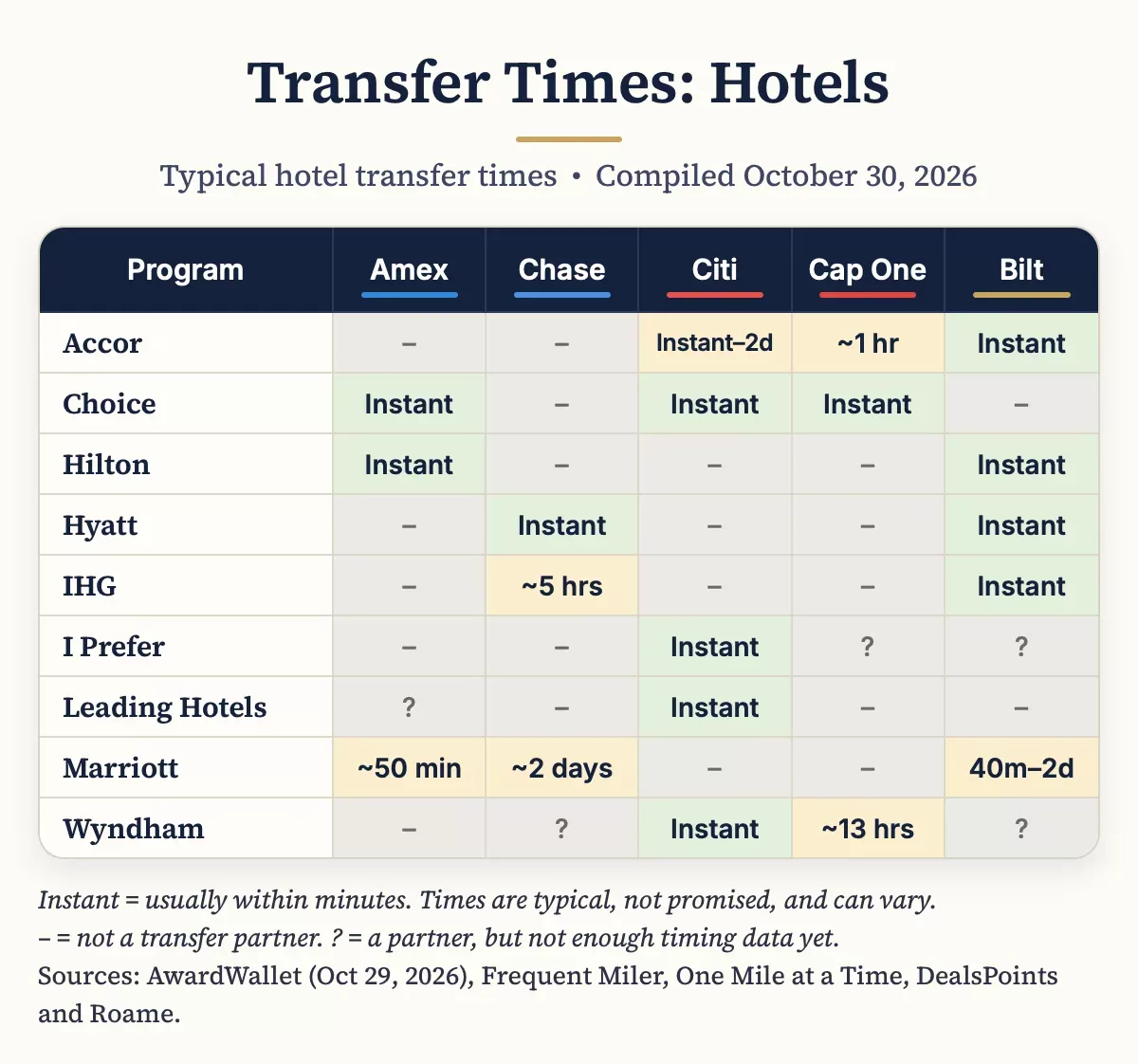
h = hours, d = days, m = minutes. Leading Hotels = Leading Hotels of the World. ? = it’s a partner, but there isn’t solid timing data yet. Ratios are in the ratio chart earlier and on my Where to Book page.
The banks say it on their own transfer screens too: Amex says most transfers post right away but can take up to 48 hours in rare cases, Chase says most post by the next business day but can take up to 7 business days, and Bilt says Hyatt transfers are usually immediate but to allow up to 48 hours. So the “Instant” you see above is the norm, not a promise.
Final Thoughts
So with all this being said and done… what’s next? Once your points land, congrats!!! You can go book that flight you’ve been eyeing (and if they’re still on the way, be patient!).
Before you move anything, run your numbers through the calculator in my Points Toolkit so you know you’re getting real value for those hard-earned points.
These are the basics of transferable points: what they are, how to transfer them, which card companies transfer to which airlines and hotels, and why it can beat the travel portals. Thanks for reading this guide, and let me know in the comments if you find more value in the travel portals or in transferring to partners!
Until the next adventure,
Trailblazin’ Half Asian
Sources (checked October 30, 2026)
Capital One: Venture miles transfer partners. Chase: Ultimate Rewards, Sapphire Preferred, Ink Business Preferred. Citi: Strata Premier, Strata cards. Amex: Membership Rewards transfers. Bilt: bilt.com. Transfer times and ratios: AwardWallet’s transfer times (updated Oct 29, 2026), Frequent Miler, One Mile at a Time, DealsPoints (Citi) and Roame. Amex fee: Your Mileage May Vary. Transfer partners and rules change often, so double check with your bank before you move points.




Comments
No comments yet. Questions about this post are welcome!